Most institutional harm does not begin with dramatic acts of open discrimination. It begins with smaller behaviors that appear ordinary, defensible, or too minor to challenge on their own.
A student gets misidentified. A teacher makes assumptions before asking questions. Discipline becomes harsher for one student than another. Complaints are treated differently depending on who speaks. Authority figures trust institutional routines more than lived experience.
Individually, each moment may appear small. Together, they create a system that slowly teaches certain people they are viewed as suspicious, less credible, more disruptive, or less deserving of protection.
This escalation process matters because systemic harm is often built from repeated micro-level decisions rather than openly declared prejudice. The damage accumulates through normalization.
Institutional Bias Usually Starts With Assumptions, Not Policies
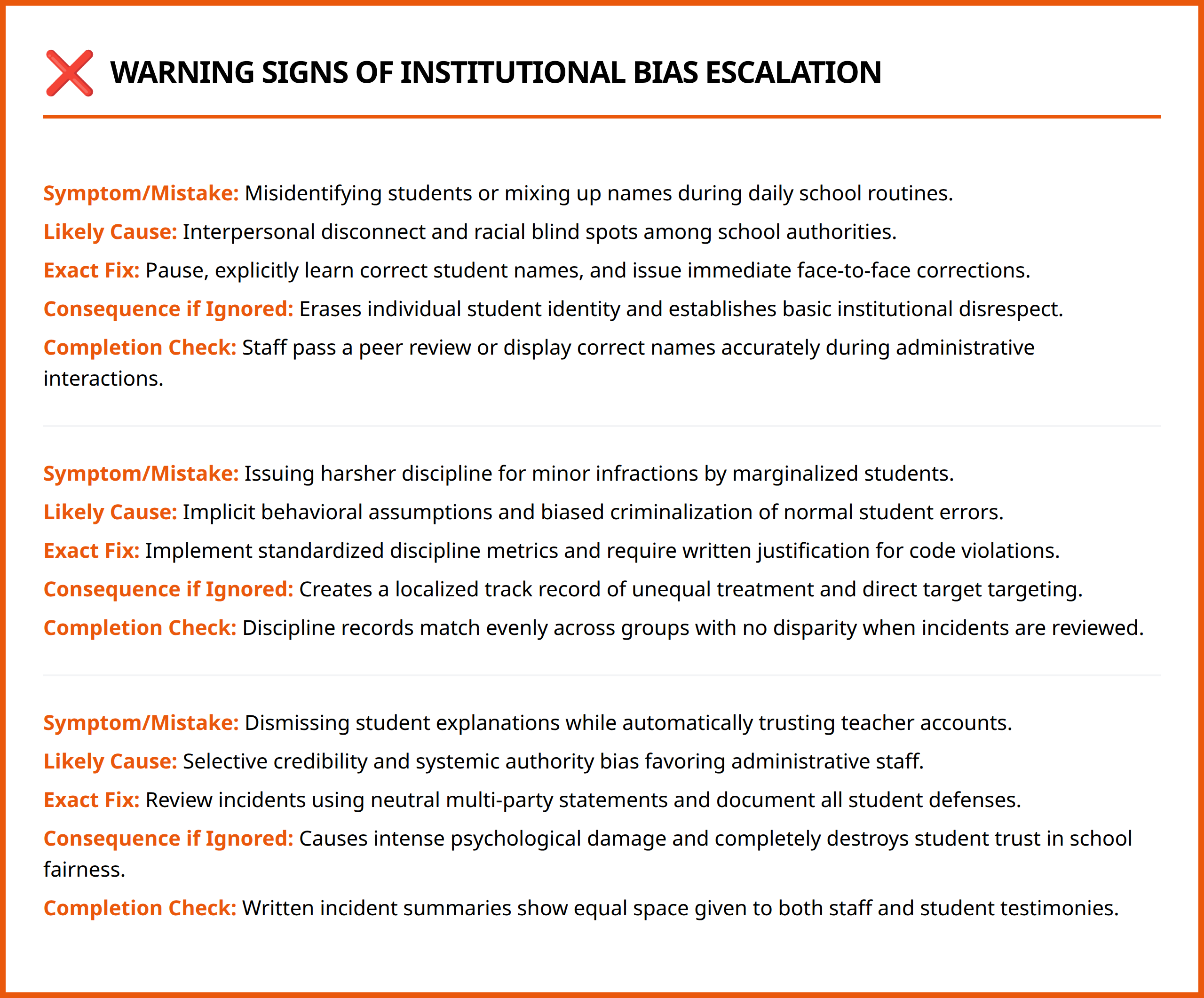
One of the most important distinctions in understanding institutional bias is that harmful outcomes often emerge before anyone openly states discriminatory intent.
The process usually begins with assumptions.
Authority figures may unconsciously assume:
- one student is more threatening than another
- certain emotional reactions are signs of aggression
- some students are naturally less trustworthy
- discipline problems reflect character instead of context
- institutional procedures are automatically fair
These assumptions shape interpretation long before formal punishment appears.
For example, two students involved in the same conflict may receive entirely different treatment because authority figures unconsciously interpret their behavior differently from the beginning. One student appears “troubled but understandable.” The other appears “disruptive” before the full situation is even examined.
I think this is where many institutions misunderstand themselves. They focus heavily on official policy while ignoring the interpretation layer that exists before policy gets applied.
Misidentification Creates the First Layer of Harm
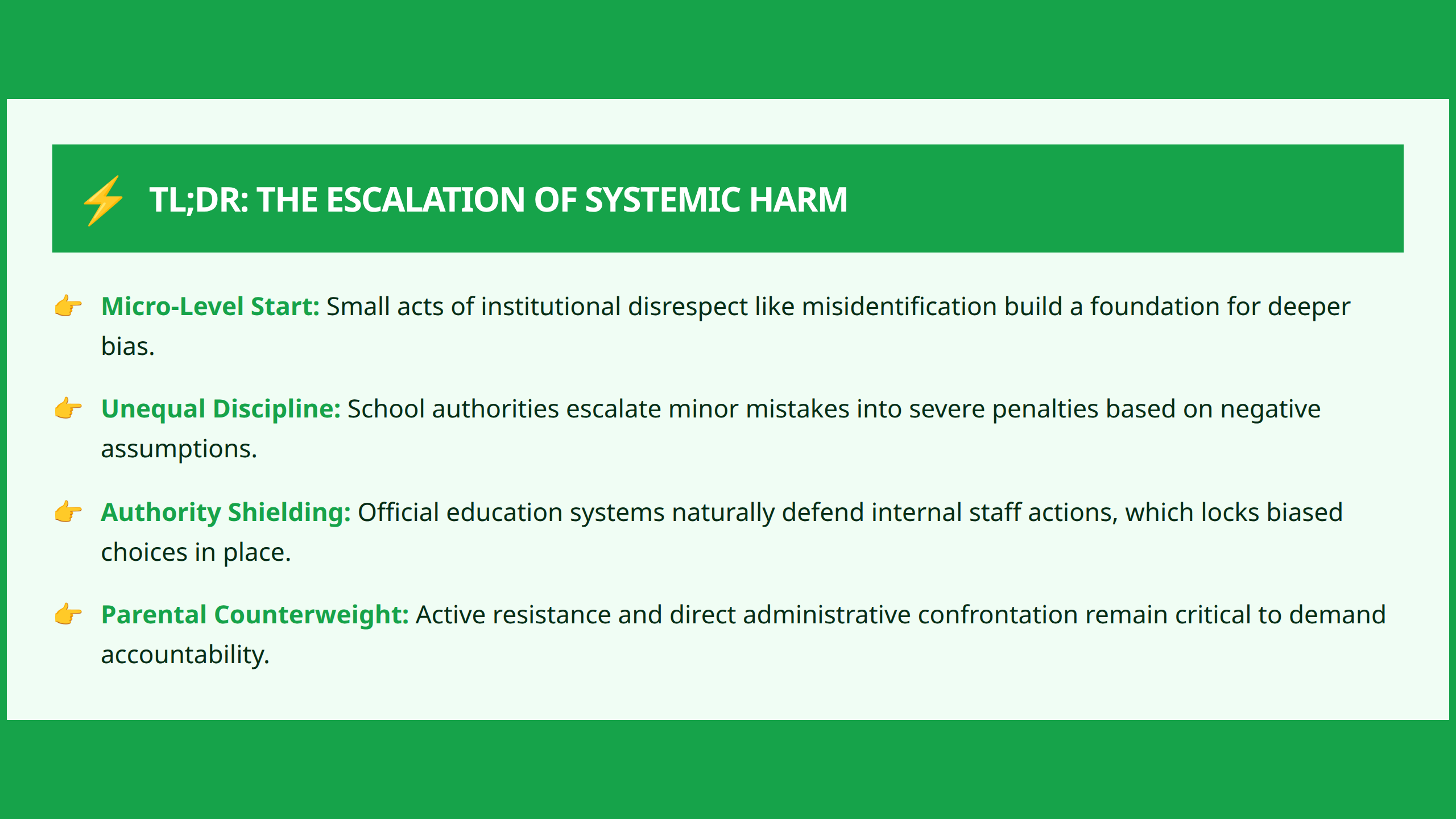
Institutional disrespect often begins through subtle forms of misrecognition.
A student may repeatedly feel:
- misunderstood
- incorrectly labeled
- viewed through stereotypes
- spoken to with suspicion
- treated as a problem before acting
Those experiences may look minor from the outside, but they create long-term psychological effects because they change how the institution relates to the individual.
Once someone becomes institutionally categorized as “difficult,” future interactions become filtered through that identity.
This creates a dangerous feedback loop:
| Initial Bias | Institutional Consequence |
|---|---|
| Student viewed suspiciously | Closer monitoring |
| Closer monitoring | More behavior interpreted negatively |
| Negative interpretation | Harsher discipline |
| Harsher discipline | Student frustration increases |
| Emotional reaction | Institution sees “proof” of original assumption |
The institution then mistakes the effects of unequal treatment for evidence that the unequal treatment was justified.
Selective Credibility Changes Everything
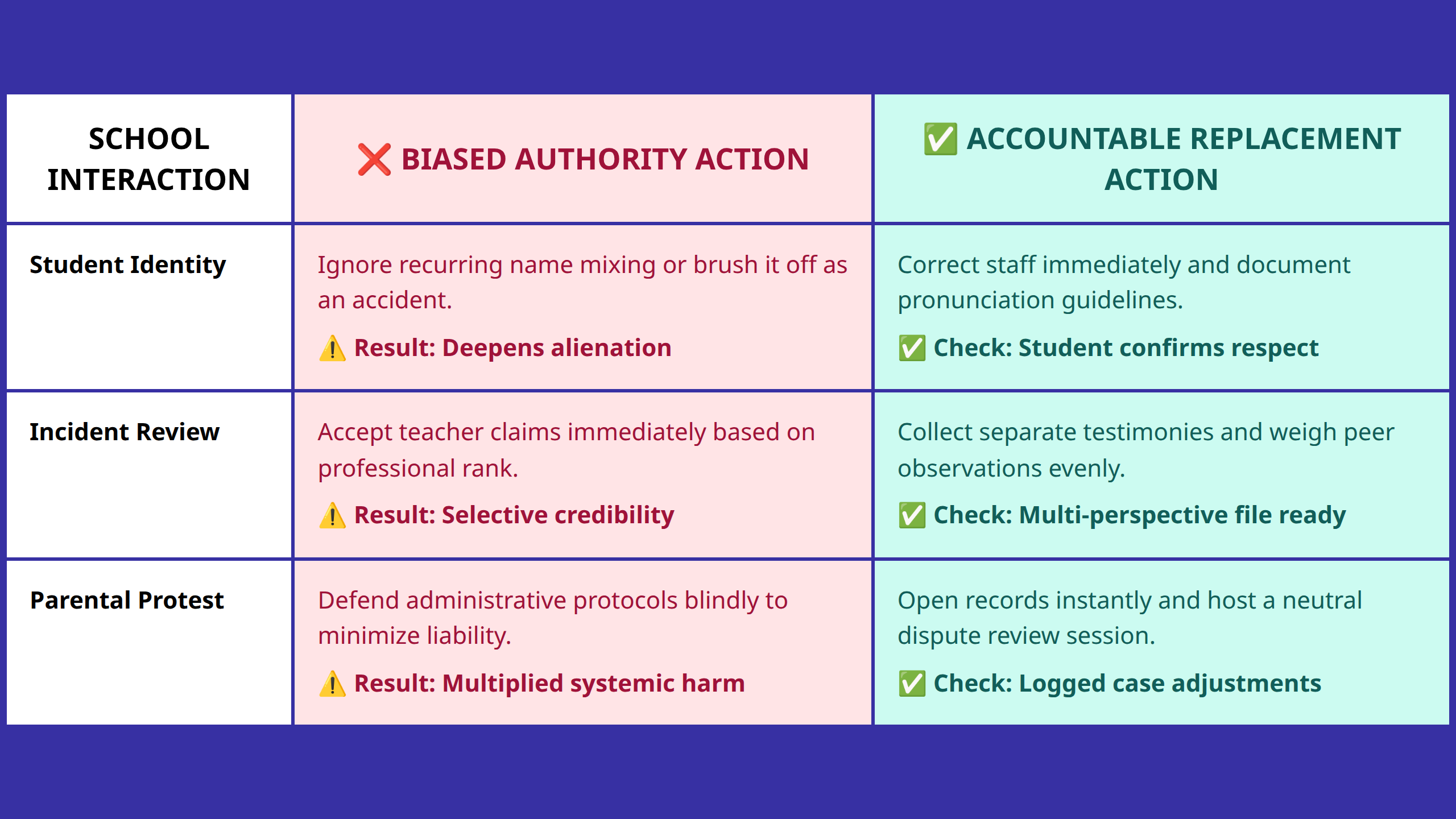
One of the clearest mechanisms behind systemic harm is selective credibility.
Institutions rarely distribute belief equally.
Some people are automatically viewed as more trustworthy because they align more closely with institutional expectations regarding behavior, communication style, social background, appearance, or authority.
This creates major consequences during conflict.
When credibility is unevenly distributed:
- certain students are interrupted more often
- certain parents are treated as “emotional” rather than informed
- some explanations receive immediate trust
- other explanations receive skepticism before evaluation
The practical effect is enormous because credibility shapes every later decision.
If an institution begins by assuming one side is more believable, all later interpretation becomes distorted.
I would pay close attention anytime institutions describe concerns as “misunderstandings” before fully examining why those misunderstandings repeatedly happen to the same kinds of people.
Unequal Discipline Often Looks Procedurally Neutral
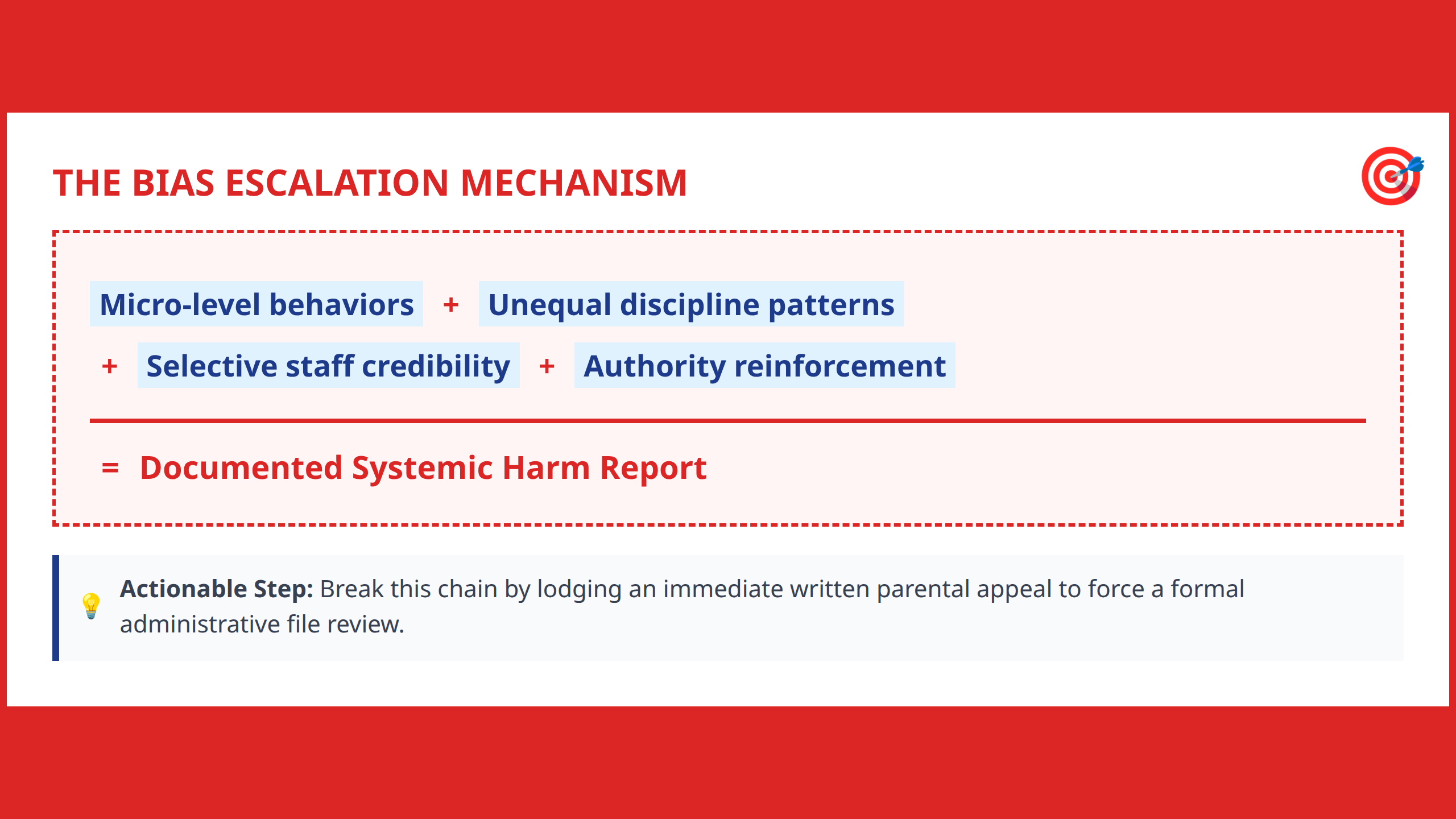
Many harmful institutional systems survive because the procedures themselves appear technically legitimate.
The issue is not always that rules are absent. The issue is how rules get interpreted and applied.
For example:
- One student receives “guidance” while another receives punishment.
- One emotional outburst is treated as stress while another is treated as defiance.
- One student gets multiple opportunities to explain while another is removed quickly from the situation.
The institution can still claim the process was procedural, organized, and policy-based.
That procedural appearance makes systemic bias difficult to challenge because the harm exists inside patterns of interpretation rather than obvious public declarations.
This is why people experiencing institutional bias often struggle to prove what they know emotionally. Each individual incident appears explainable in isolation. The pattern only becomes visible across repeated experiences.
Authority Systems Reinforce Their Own Assumptions
Institutions tend to trust their own internal logic.
Once an authority figure records a negative interpretation, future authority figures may inherit that interpretation automatically. Institutional memory becomes self-reinforcing.
This creates escalation.
A student who has already been framed as problematic may:
- receive less patience
- be monitored more closely
- encounter quicker disciplinary escalation
- face reduced empathy during conflict
- lose opportunities for fair interpretation
The institution begins responding not only to current behavior, but to an accumulated narrative about the individual.
That narrative may contain distortions created by earlier assumptions, yet later authority figures treat it as objective history.
Why Parents Often Become Threats to Institutional Stability
One important escalation point appears when parents challenge institutional narratives directly.
At that stage, the conflict is no longer only about the original treatment. It becomes about institutional legitimacy itself.
Administrations frequently respond defensively when confronted because acknowledging unequal treatment can threaten confidence in the system.
Several patterns often emerge:
- the institution reframes criticism as emotional overreaction
- procedural language replaces meaningful accountability
- authority figures defend process instead of outcomes
- parents are treated as disruptive rather than concerned
This reaction matters because institutions often protect stability instinctively. Even well-meaning systems can become resistant to acknowledging bias if doing so threatens their self-image as fair and orderly.
I find this especially important because many people imagine institutional bias requires openly prejudiced individuals. In reality, harm can persist inside systems full of people who sincerely believe they are behaving reasonably.
Three Practical Questions That Reveal Escalating Institutional Bias
Systemic harm becomes easier to recognize when people stop evaluating incidents individually and start evaluating patterns.
1. Who Gets Interpreted as Dangerous First?
The earliest assumptions often reveal the institution’s deeper biases.
2. Who Receives the Benefit of Explanation?
Fair systems distribute empathy consistently during conflict, especially before conclusions are finalized.
3. Who Is Expected to Stay Calm to Be Believed?
One common institutional bias appears when emotionally affected individuals are treated as less credible precisely because they are reacting to unfair treatment.
Normalization Is What Makes Institutional Harm Durable
The most troubling part of systemic bias is how ordinary it can begin to feel.
Small unequal interactions become routine. Authority assumptions become institutional memory. Unequal treatment becomes interpreted as common sense. Over time, the system stops noticing its own escalation patterns.
That normalization creates psychological damage far beyond individual disciplinary moments. Students begin learning where they stand socially inside the institution. They learn whose discomfort matters, whose credibility counts, and whose behavior receives automatic suspicion.
The danger is not only the original bias. The deeper danger is the way repeated institutional responses quietly transform unequal treatment into accepted reality.
References:
- https://www.vantageleadership.com/our-blog/the-organizational-harm-done-by-everyday-prejudice/
- https://beeckcenter.georgetown.edu/bias-has-consequences-disrupting-the-cycle-of-everyday-racism/
- https://pmc.ncbi.nlm.nih.gov/articles/PMC8688641/
- https://pulsely.io/blog/5-ways-to-become-more-conscious-about-systemic-bias
- https://www.sciencedirect.com/org/science/article/pii/S2040714926000069
- https://fiveable.me/global-perspectives-on-identity-and-diversity/unit-5/systemic-discrimination-institutional-bias/study-guide/vfrszine97iLpeSW
- https://sparq.stanford.edu/products/sparq-insights-race-and-policing
- https://pmc.ncbi.nlm.nih.gov/articles/PMC9750505/
- https://yjlc.uk/resources/legal-updates/30-patterns-harm-structural-review-systematic-racism-within-london
- https://compass.onlinelibrary.wiley.com/doi/10.1111/spc3.12930
- https://www.ncbi.nlm.nih.gov/books/NBK589697/
- https://agep-nc.org/wp-content/uploads/2022/03/Henry-chapter-institutiona-bias-2010.pdf
