Most investors believe their biggest problem is lack of information. In reality, the bigger problem is often the inability to think clearly when money, uncertainty, fear, and excitement become involved. That is why people repeatedly buy stocks near peaks, panic during declines, chase trends too late, and ignore business fundamentals when emotions take over.
The uncomfortable part is that these mistakes are usually predictable. Investors tend to repeat the same behavioral patterns because the human brain was not designed for volatile financial markets. Markets constantly trigger emotional reactions, and without a disciplined process, those reactions quietly begin making decisions for you.
This is where behavioral finance becomes practical rather than theoretical. It explains why intelligent people can still make poor investing decisions even when the information is publicly available.
Why Emotional Investing Feels Rational in the Moment
One of the most dangerous aspects of investing psychology is that emotional decisions rarely feel emotional while they are happening. They usually feel logical.
During strong bull markets, optimism feels justified because prices keep rising. During market crashes, fear feels rational because losses become visible everywhere. Investors often confuse emotional comfort with analytical clarity.
I find this distinction useful because many people assume emotional investing looks dramatic or reckless. Often it looks completely normal. It can appear as:
- Buying after several weeks of positive headlines
- Selling because “everyone” suddenly sounds worried
- Holding losers because admitting a mistake feels painful
- Ignoring risk because recent gains create confidence
- Overreacting to short-term market volatility
The underlying issue is not intelligence. It is the interaction between uncertainty and human psychology.
The Two Systems That Shape Investment Decisions
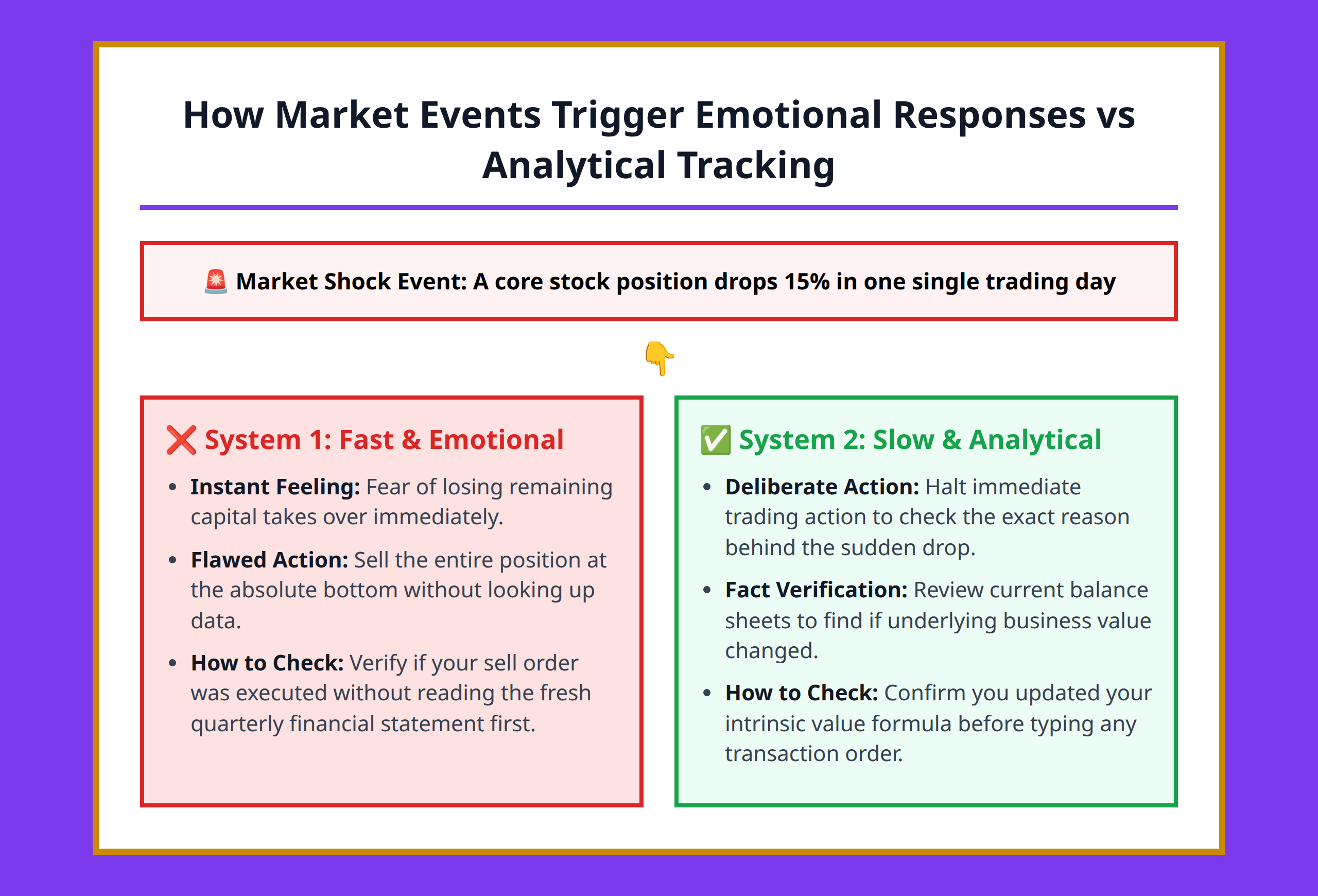
A useful way to think about investing psychology is through two different modes of thinking.
The first system is fast, automatic, emotional, and instinctive. It reacts quickly to danger, excitement, headlines, and social pressure. The second system is slower, analytical, deliberate, and process-oriented.
In investing, the fast system often dominates when markets become emotionally intense.
| Fast Emotional Thinking | Slow Analytical Thinking |
|---|---|
| Reacts quickly | Evaluates carefully |
| Driven by fear or excitement | Driven by evidence and process |
| Focuses on price movement | Focuses on business fundamentals |
| Short-term oriented | Long-term oriented |
| Socially influenced | Independently reasoned |
The problem is not that emotional thinking exists. Humans need it in many situations. The problem is that stock markets constantly trigger the wrong mode of thinking at the wrong time.
A rapidly rising stock activates excitement and fear of missing out. A collapsing stock activates loss aversion and panic. In both cases, emotional reactions arrive faster than disciplined analysis.
Why Investors Buy High Instead of Buying Rationally
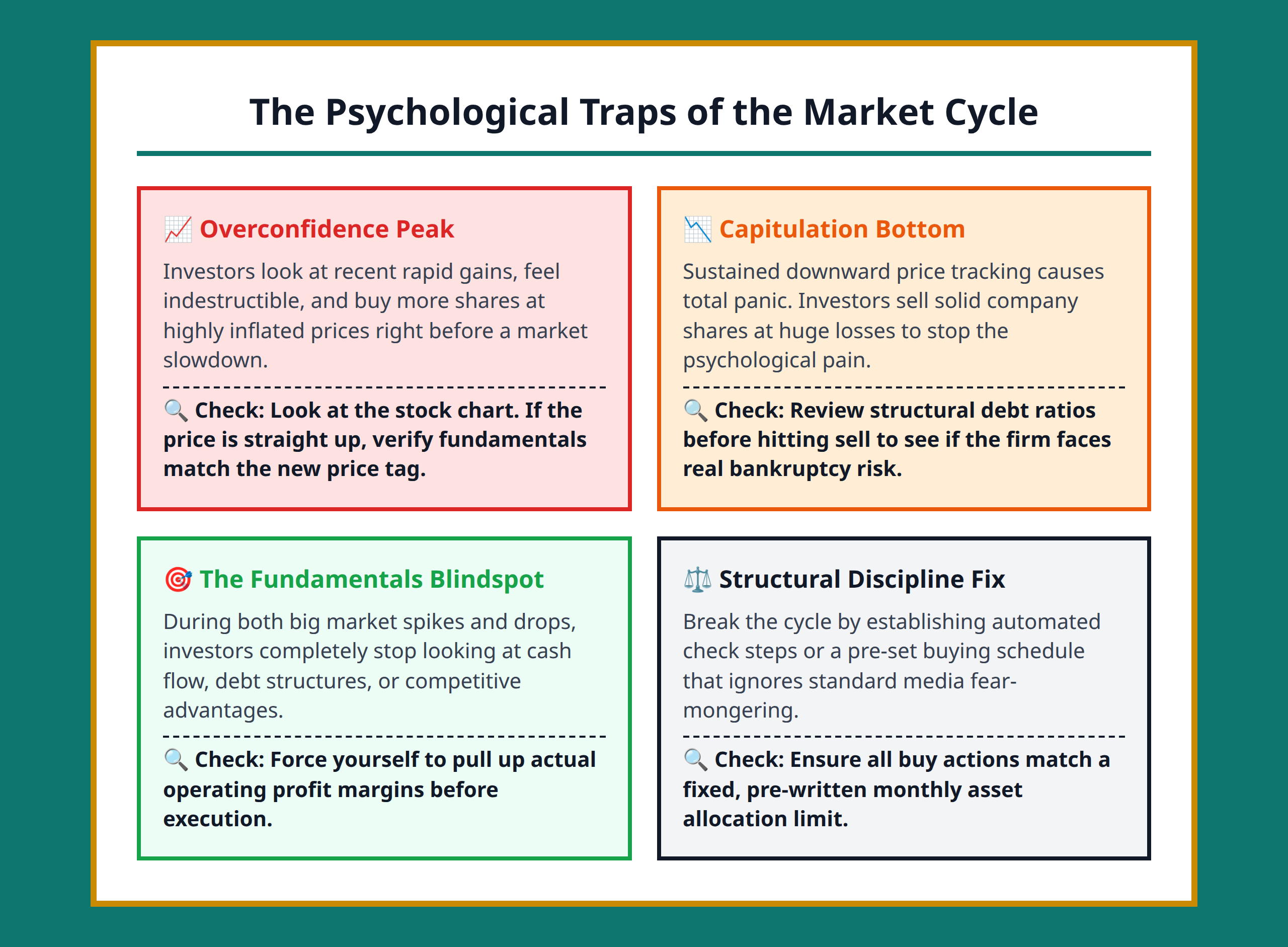
One of the most common behavioral mistakes is buying after large price increases instead of before them.
At first glance this seems irrational, but psychologically it makes sense. Rising prices create social proof. Investors begin hearing success stories, positive narratives, analyst upgrades, and optimistic forecasts. Confidence grows precisely because the stock already moved higher.
This creates a dangerous feedback loop:
- Prices rise
- Attention increases
- Confidence increases
- More buyers enter
- Prices rise further
Eventually the stock itself becomes the reason people buy the stock.
A practical example is the way speculative technology rallies often unfold. Investors stop asking whether the business is fundamentally strong and instead focus almost entirely on recent momentum. Valuation discipline weakens because emotional excitement replaces analytical restraint.
I would not treat this as proof that every rapidly rising stock is bad. Strong companies can absolutely justify long-term appreciation. The issue is when investors abandon process and begin assuming recent price movement itself validates the investment.
Why Investors Sell Low During Market Declines
Fear changes investor behavior faster than optimism does.
During market declines, people suddenly focus on short-term survival instead of long-term business quality. Investors who previously ignored risk become consumed by it. Losses feel emotionally heavier than gains feel rewarding.
This creates another predictable cycle:
- Prices fall sharply
- Fear spreads
- Investors focus on recent losses
- Selling accelerates
- Prices decline further
The emotional pain of losing money often becomes stronger than the original investment thesis.
One practical example is a market-wide selloff where fundamentally strong businesses decline alongside weaker companies. Investors who never built conviction through research suddenly cannot distinguish between temporary volatility and permanent business deterioration.
That distinction matters enormously.
A company experiencing temporary price weakness is very different from a company experiencing structural business collapse. Emotional investors often treat both situations the same because panic compresses analytical thinking.
How Cognitive Biases Quietly Distort Stock Decisions
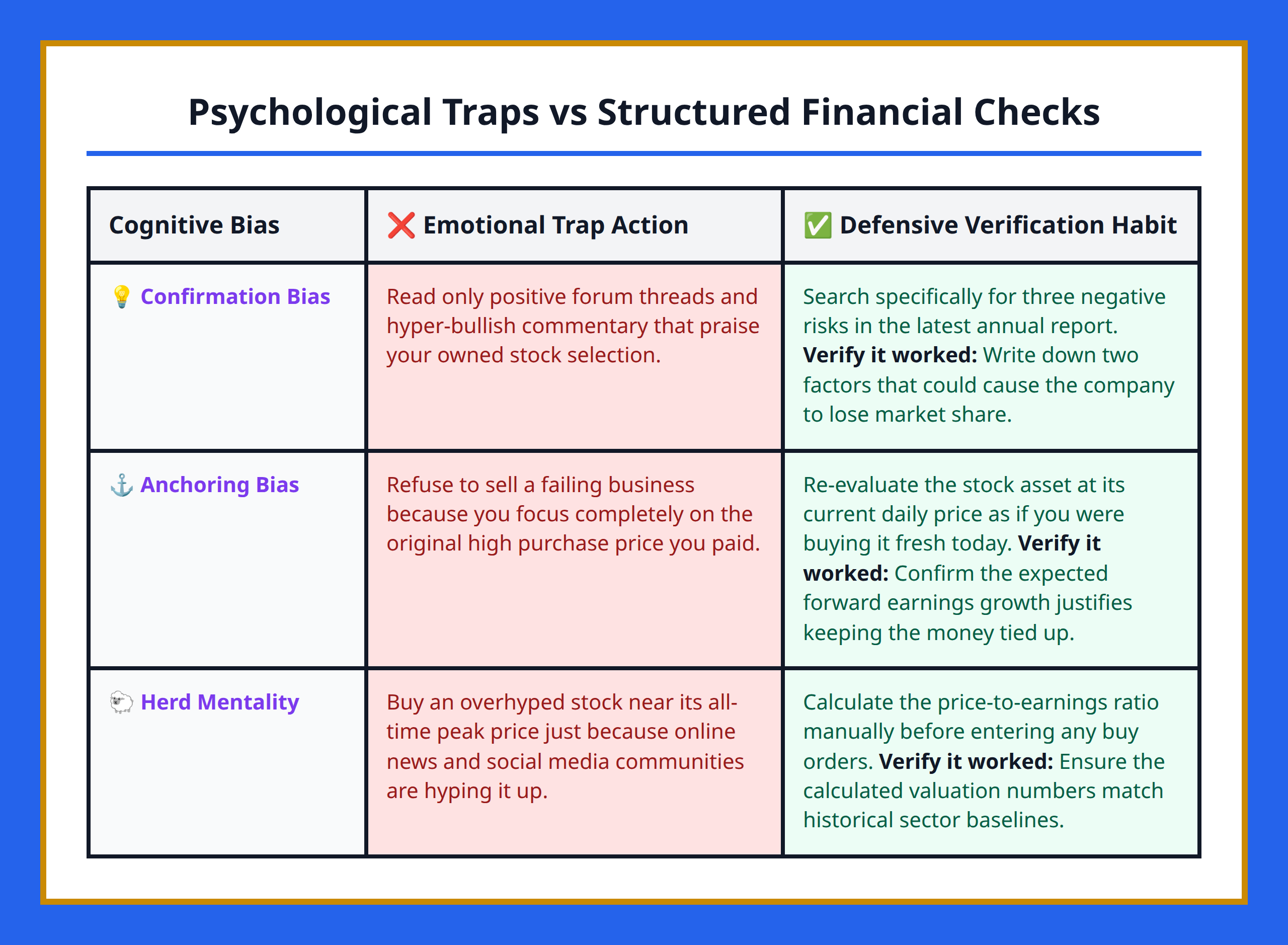
Behavioral mistakes are not random. They usually follow recognizable psychological patterns.
Confirmation Bias
Investors naturally search for information that supports existing beliefs while ignoring contradictory evidence.
For example, someone bullish on a company may consume only optimistic research, positive interviews, and favorable commentary while dismissing legitimate risks.
The dangerous part is that confirmation bias creates the illusion of research depth while actually narrowing perspective.
Recency Bias
Recent events feel more important than older information.
After long bull markets, investors begin assuming strong returns are normal. After market crashes, investors begin assuming weakness will continue indefinitely.
This bias becomes especially dangerous because markets are cyclical. Investors often extrapolate recent trends far into the future precisely when conditions are most likely to change.
Overconfidence Bias
Success can quietly damage discipline.
Investors who experience strong returns may begin attributing all positive outcomes to skill rather than favorable market conditions, timing, or luck. Research standards weaken because confidence increases faster than analytical accuracy.
I have always found this one particularly dangerous because overconfidence often appears after periods of success rather than failure.
Loss Aversion
People feel losses more intensely than equivalent gains.
This creates strange behavior patterns:
- Selling winners too early to “lock in gains”
- Holding losing positions too long to avoid admitting mistakes
- Avoiding rational risk because recent losses created fear
Emotionally, realizing a loss feels like failure. Analytically, however, exiting a broken investment thesis can be the correct decision.
Why Information Alone Does Not Fix These Problems
Many investors assume better information automatically leads to better decisions. That is only partially true.
Psychological mistakes often happen despite access to information. The issue is interpretation and behavior under pressure.
For example:
- An investor may understand valuation principles yet still chase momentum
- An investor may recognize risk but ignore it during euphoric markets
- An investor may know a business is strong but still panic during volatility
This is why emotional discipline matters as much as analytical skill.
The Role of Process in Controlling Investor Psychology
Psychology becomes more manageable when decisions are tied to structure instead of impulse.
A repeatable research process acts like a stabilizing mechanism during emotionally unstable periods.
Instead of reacting emotionally, disciplined investors return to predefined questions:
- Has the business fundamentally changed?
- Was the original investment thesis broken?
- Are current fears temporary or structural?
- Did valuation become irrationally extreme?
- Am I reacting to price movement or business reality?
The important shift is moving from reaction-based investing toward process-based investing.
One practical observation here: investors often think process slows them down too much. In reality, process mainly slows down emotional mistakes.
A Simple Behavioral Checklist Before Buying or Selling
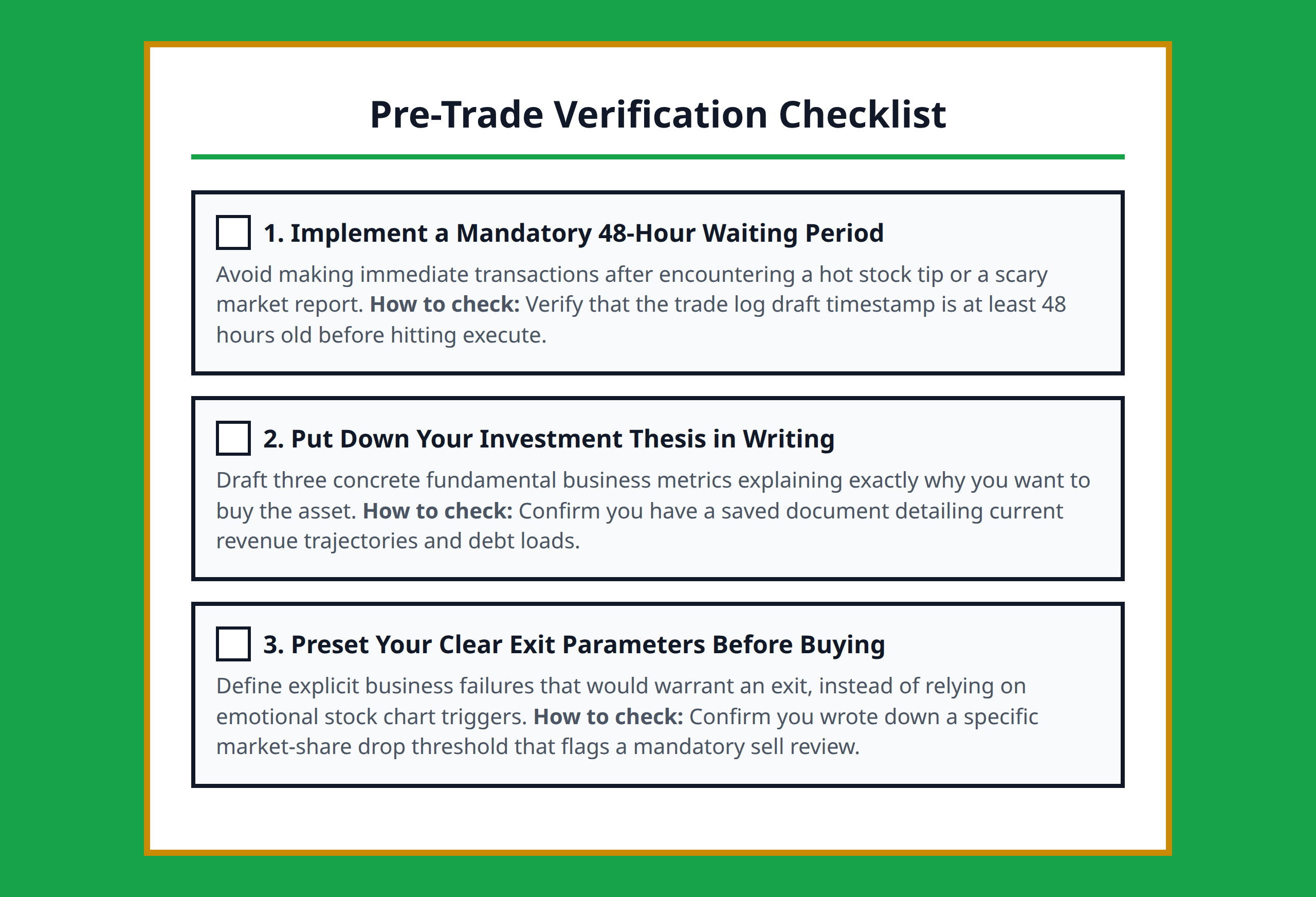
One of the easiest ways to improve investing discipline is to interrupt emotional momentum before making decisions.
This checklist works because it forces slower analytical thinking to re-enter the process.
| Question | Purpose |
|---|---|
| Why am I buying or selling right now? | Separates reasoning from impulse |
| Has the business actually changed? | Distinguishes fundamentals from price action |
| Would I make the same decision without today’s headlines? | Reduces emotional influence |
| Am I reacting to fear or excitement? | Identifies emotional triggers |
| Did I define my investment thesis clearly? | Reconnects decisions to research |
This kind of checklist sounds simple, but simplicity is often what makes it usable during stressful market environments.
Why Discipline Matters More Than Predicting Markets
Most investors will never eliminate emotional reactions entirely. Markets are too uncertain and money is too psychologically powerful for that.
The real goal is not emotional perfection. The goal is creating enough structure to prevent emotions from dominating decisions.
That usually means:
- Building conviction through research before investing
- Separating price volatility from business quality
- Using written investment theses
- Reviewing risks before buying
- Accepting uncertainty instead of chasing certainty
Over time, disciplined investors begin noticing something important: the market often becomes most emotionally persuasive at exactly the wrong moments. Extreme optimism frequently appears near peaks. Extreme fear frequently appears near bottoms.
Recognizing that pattern does not make investing easy. But it does create a major advantage over investors whose decisions are driven primarily by emotion instead of process.
References:
- https://www.investopedia.com/terms/m/marketpsychology.asp
- https://www.reddit.com/r/BehavioralEconomics/comments/1tje511/psychology_of_a_retail_investor_7_biases_that_are/
- https://www.quora.com/Why-is-it-psychologically-difficult-for-investors-to-buy-high-and-sell-higher
- https://www.reddit.com/r/investing_discussion/comments/1tje4kt/psychology_of_a_retail_investor_7_biases_that_are/
- https://towerpointwealth.com/the-psychology-of-market-cycles/
- https://www.wilmingtontrust.com/content/dam/wtb-web/wtb-migration/pdfs/Behavioral-Finance-Investor-Psychology-How-Emotions-Can-Color-Our-Decisions.pdf
- https://www.bajajamc.com/knowledge-centre/buy-high-sell-low-behavioural-investing
- https://iv-capital.com/the-psychology-of-market-cycles-how-investor-behavior-shapes-booms-and-busts/
- https://www.linkedin.com/top-content/business-strategy/understanding-investment-concepts/understanding-investor-behavior-patterns/
- https://www.heygotrade.com/en/blog/psychology-in-investing/
- https://www.thrivent.com/insights/investing/mastering-market-psychology-how-emotions-impact-investment-decisions
- https://www.investing.com/analysis/the-psychology-of-investing-in-a-zerorisk-illusion-200668707
- https://www.investopedia.com/articles/investing/081415/look-buy-low-sell-high-strategy.asp
