Most investors experience market crashes emotionally before they experience them analytically. Falling prices trigger fear, uncertainty, regret, and urgency. Portfolios shrink rapidly, headlines become aggressively negative, and many investors stop thinking about business value entirely. But disciplined fundamental investors often approach the same environment very differently. Instead of asking only how far prices may continue falling, they begin asking whether fear has pushed strong businesses below reasonable value.
This distinction matters because market crashes frequently create a temporary disconnect between psychology and fundamentals. During stable environments, prices and business value may move relatively close together. During panic-driven selloffs, emotional behavior can dominate rational evaluation for extended periods.
I would think about it this way: crashes do not only destroy confidence. They also expose how differently investors react under pressure.
Why Fear Changes Investor Behavior So Quickly
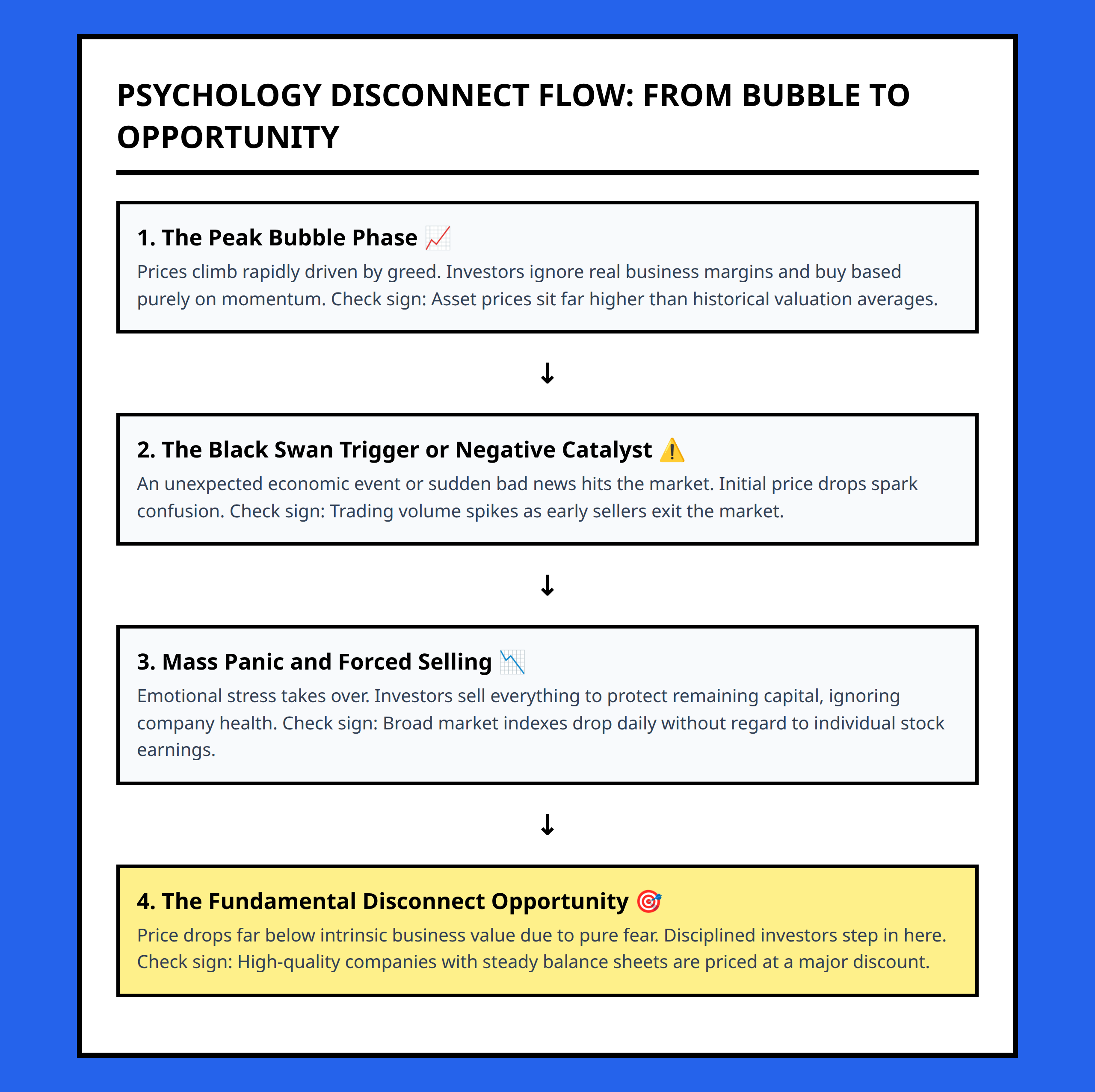
One of the defining characteristics of market downturns is the speed at which investor psychology shifts.
During strong bull markets, investors often assume:
- Growth will continue smoothly
- Risk is manageable
- High valuations are justified
- Recent winners will keep winning
But once markets begin declining sharply, the emotional framework reverses almost immediately.
Investors suddenly focus on:
- Capital preservation
- Worst-case scenarios
- Liquidity concerns
- Short-term survival
- Recent losses
The important observation is that market psychology tends to swing between emotional extremes. Optimism becomes excessive during booms, while fear becomes excessive during crashes.
I find this useful because many investors assume panic-driven markets become highly rational. In reality, emotionally stressed markets can distort pricing just as euphoric markets can.
Why Market Crashes Often Pull Strong and Weak Companies Down Together
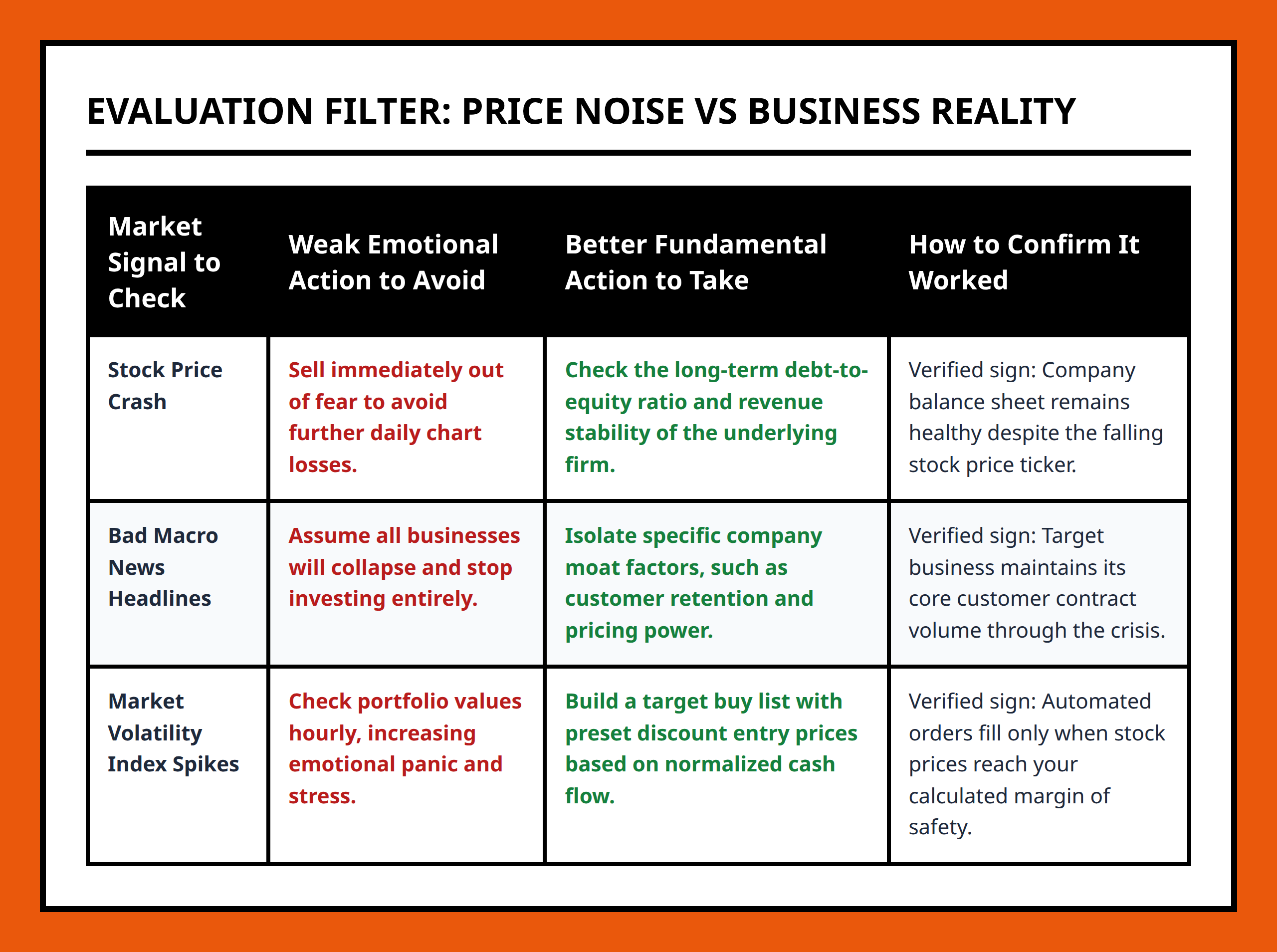
One of the most important features of broad market selloffs is that investors frequently sell indiscriminately.
During panic phases:
- Strong companies may decline alongside weak companies
- Temporary uncertainty may be treated like permanent collapse
- Liquidity needs may force widespread selling
- Fear may overwhelm business-specific analysis
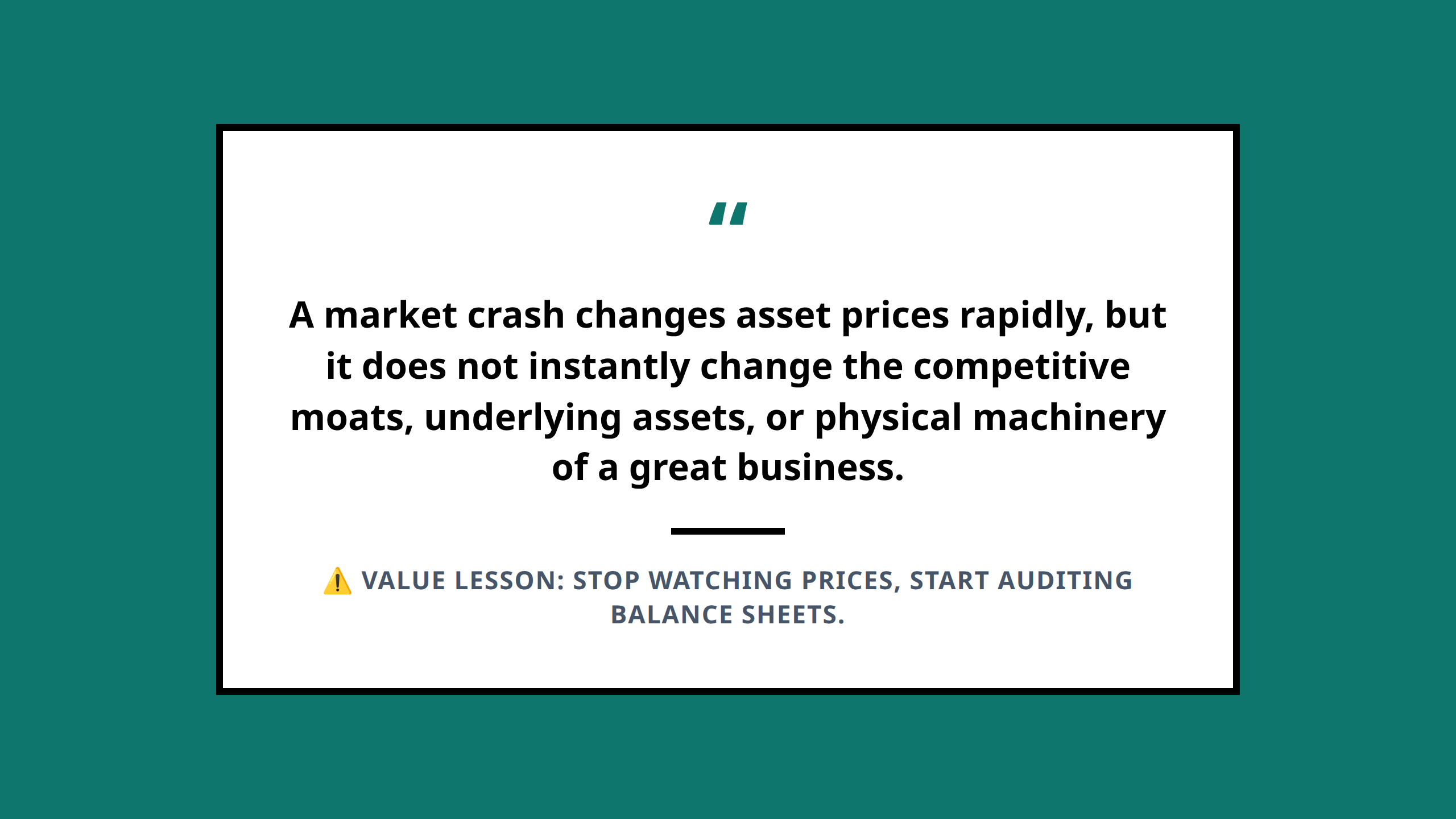
This creates situations where stock prices fall faster than underlying business quality deteriorates.
A practical example is a profitable company with strong cash generation, durable demand, and manageable debt declining heavily during a broad market crash simply because investors want to reduce overall exposure quickly.
The decline itself does not automatically mean the business became structurally worse. Sometimes the primary change is emotional sentiment rather than long-term economics.
How Fundamental Investors Separate Price Movement From Business Value
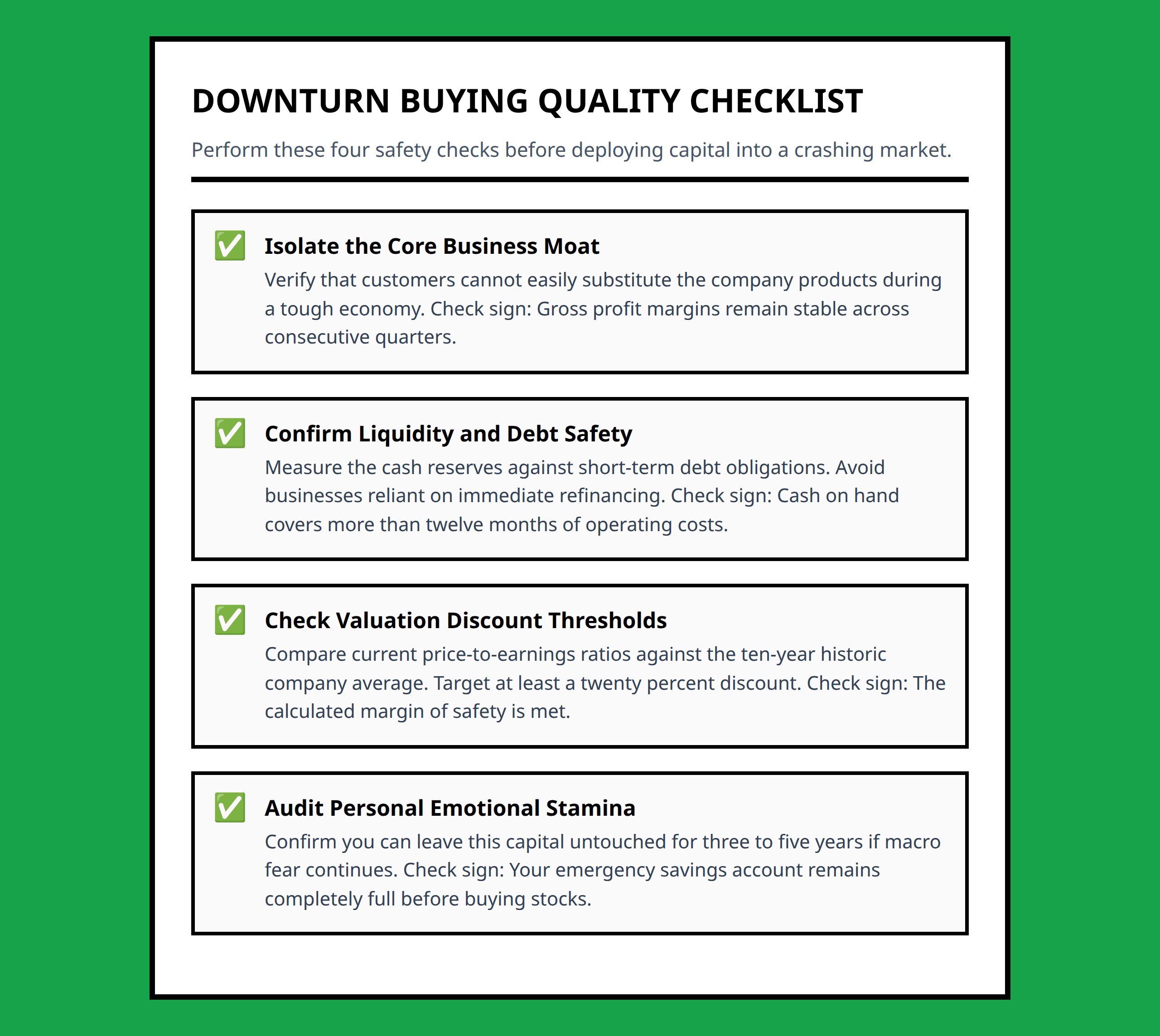
Fundamental investors attempt to evaluate whether market fear reflects genuine business deterioration or temporary emotional overreaction.
This process requires separating two different questions:
| Market Psychology Question | Fundamental Investing Question |
|---|---|
| How scared are investors right now? | How strong is the business itself? |
| How fast is the stock falling? | Did long-term earning power change? |
| What is current sentiment? | What is intrinsic value? |
| Will panic continue tomorrow? | Can the company survive and compound over time? |
| What are traders reacting to? | What do the fundamentals actually suggest? |
This distinction becomes extremely important during crashes because emotional markets often compress analytical thinking.
I would not treat every declining stock as a buying opportunity. Some companies genuinely face structural problems during recessions, credit stress, or economic disruption. The challenge is distinguishing temporary fear from permanent damage.
Why Market Crashes Create Opportunity for Disciplined Investors
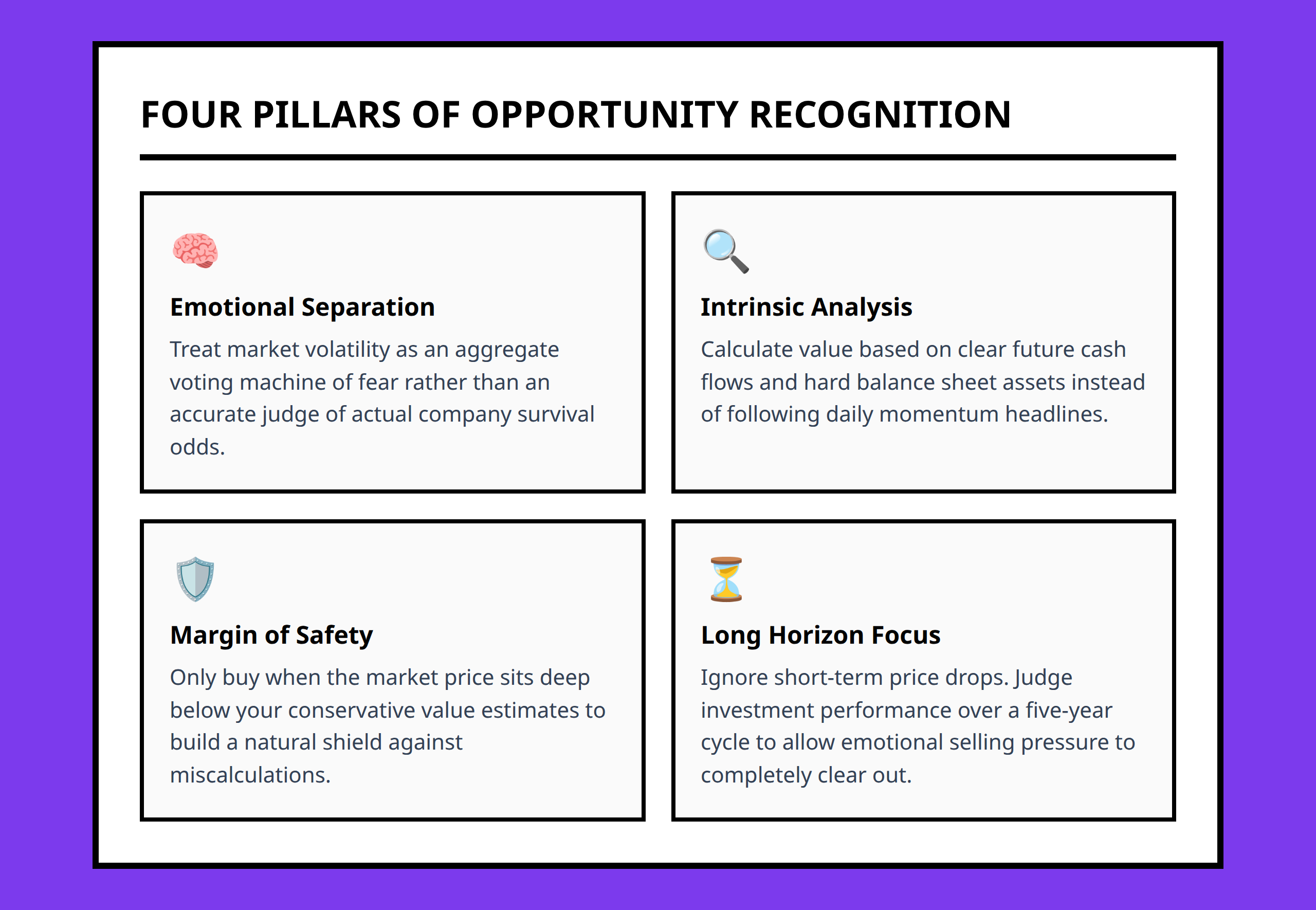
When fear spreads broadly, investors sometimes begin prioritizing emotional relief over rational valuation.
That behavior can create opportunity because:
- High-quality businesses may trade at unusually attractive valuations
- Future expectations may become excessively pessimistic
- Short-term uncertainty may overshadow long-term durability
- Strong companies may temporarily become mispriced
Fundamental investors often look for situations where:
- The business remains financially strong
- Competitive advantages still exist
- Demand likely survives beyond the crisis
- The market reaction appears emotionally amplified
A useful way to understand this is that fear changes what investors focus on. During crashes, the market may temporarily care more about immediate emotional discomfort than long-term business economics.
How Bubbles and Crashes Follow Similar Psychological Patterns
Interestingly, speculative bubbles and panic crashes often reflect the same underlying psychological mechanism.
During bubbles:
- Investors extrapolate positive outcomes too far
- Risk appears smaller than reality
- Momentum reinforces optimism
During crashes:
- Investors extrapolate negative outcomes too far
- Risk appears larger than reality
- Fear reinforces pessimism
In both cases, emotional extremes distort valuation discipline.
I think this is one of the most overlooked parts of investing psychology. Investors often believe panic markets are automatically more rational because fear feels serious and urgent. But emotional pessimism can distort judgment just as aggressively as emotional optimism.
Why Black Swan Events Intensify Emotional Selling
Unexpected market shocks create especially powerful emotional reactions because uncertainty becomes difficult to measure.
Black Swan-style events often involve:
- Sudden economic disruption
- Unexpected financial stress
- Sharp liquidity shocks
- Rapid narrative collapse
- Extreme uncertainty about future outcomes
Under these conditions, investors frequently shift from analytical thinking toward defensive emotional behavior.
For example:
- Investors may sell simply because uncertainty feels unbearable
- Businesses may be priced as if temporary problems are permanent
- Long-term valuation analysis may temporarily disappear from decision-making
The important point is not pretending uncertainty becomes harmless. Genuine risks absolutely exist during crisis periods. But emotionally unstable environments can also create exaggerated pricing dislocations.
What Fundamental Investors Look For During Market Panic
Disciplined investors usually focus less on predicting the exact market bottom and more on identifying businesses likely to remain strong after the crisis eventually stabilizes.
That process often includes evaluating:
- Balance-sheet strength
- Cash-flow durability
- Industry resilience
- Competitive positioning
- Management discipline
- Reasonable long-term valuation
A practical example is comparing two declining companies during a downturn:
| Financially Fragile Company | Financially Durable Company |
|---|---|
| Heavy debt burden | Manageable debt levels |
| Weak cash generation | Consistent cash flow |
| Temporary demand speculation | Established demand base |
| Depends heavily on optimism | Supported by durable operations |
| Higher survival risk | Higher recovery potential |
The goal is not simply buying declining stocks. The goal is identifying situations where fear appears disproportionate relative to long-term business quality.
Why Emotional Discipline Matters More During Crashes
Market crashes test emotional discipline more aggressively than analytical intelligence.
Many investors know theoretically that markets are cyclical. But emotionally, sharp losses can still create panic-driven decision-making.
This is why disciplined investors often rely on predefined frameworks during downturns.
Questions may include:
- Did the business fundamentally deteriorate?
- Is the balance sheet still strong?
- Did fear push valuation below reasonable assumptions?
- Am I reacting emotionally to volatility?
- Would I view this company differently if the stock price were hidden?
I would avoid assuming emotional control means feeling calm during crashes. Even experienced investors feel uncertainty during severe downturns. The difference is usually whether decisions remain anchored to analysis rather than panic alone.
How Long-Term Investors Reframe Market Downturns
Short-term traders often experience crashes primarily as threats. Long-term fundamental investors may also view them as periods where future return potential improves because prices adjust faster than long-term business value.
This does not mean crashes are pleasant or easy. Severe downturns can last longer than expected, and uncertainty can remain high for extended periods.
But historically, emotionally extreme environments often create the largest disconnects between fear-driven pricing and durable business fundamentals.
The practical lesson is not that every crash creates automatic bargains. It is that panic markets frequently force investors to choose between emotional reaction and disciplined evaluation. Fundamental investors attempt to use that emotional imbalance carefully rather than becoming controlled by it.
References:
- https://www.vaneck.com.au/blog/investing/historical-market-crashes-recoveries-lessons/
- https://moneyandinvesting.com.au/blog/strategies-for-handling-market-crashes/
- https://www.investopedia.com/articles/01/030701.asp
- https://www.cioinvestmentclub.com/fear-and-greed-cycle
- https://www.reddit.com/r/Fire/comments/1mucch2/for_experienced_investors_how_did_people_react/
- https://www.reddit.com/r/Fire/comments/1mucch2/for_experienced_investors_how_did_people_react/n9i94e3/
- https://www.reddit.com/r/Fire/comments/1mucch2/for_experienced_investors_how_did_people_react/n9htqp6/
- https://www.reddit.com/r/investingforbeginners/comments/1j97zjz/the_stock_market_is_crashinghere_are_some_dos_and/
- https://www.bogleheads.org/forum/viewtopic.php
- https://www.betashares.com.au/insights/worried-about-market-volatility/
- https://www.reddit.com/r/ValueInvesting/comments/1teexeo/how_do_longterm_investors_handle_market_crashes/
- https://www.reddit.com/r/Fire/comments/14t44cf/those_of_you_who_are_afraid_of_a_general_market/
- https://www.miraeassetmf.co.in/knowledge-center/importance-of-investor-behaviour-in-market-correction-greed-and-fear-cycle
- https://smallcaps.com.au/article/how-to-overcome-irrational-fear-share-market-crashes
- https://www.novuscapital.com.au/novus-notes/why-stock-market-panic-can-signal-a-good-time-to-buy
- https://www.home.saxo/learn/guides/start-investing/how-to-overcome-the-fear-of-investing
- https://www.reddit.com/r/Fire/comments/1mucch2/for_experienced_investors_how_did_people_react/n9hv2z9/
