Many investors analyze stocks by focusing on only one variable at a time. Some obsess over valuation ratios. Others chase growth trends, momentum, or market narratives. But strong long-term investing usually depends on understanding how multiple business factors interact together. A company can appear cheap while facing structural decline. A fast-growing company can still become a poor investment if expectations become unrealistic. Looking at isolated metrics often creates incomplete analysis.
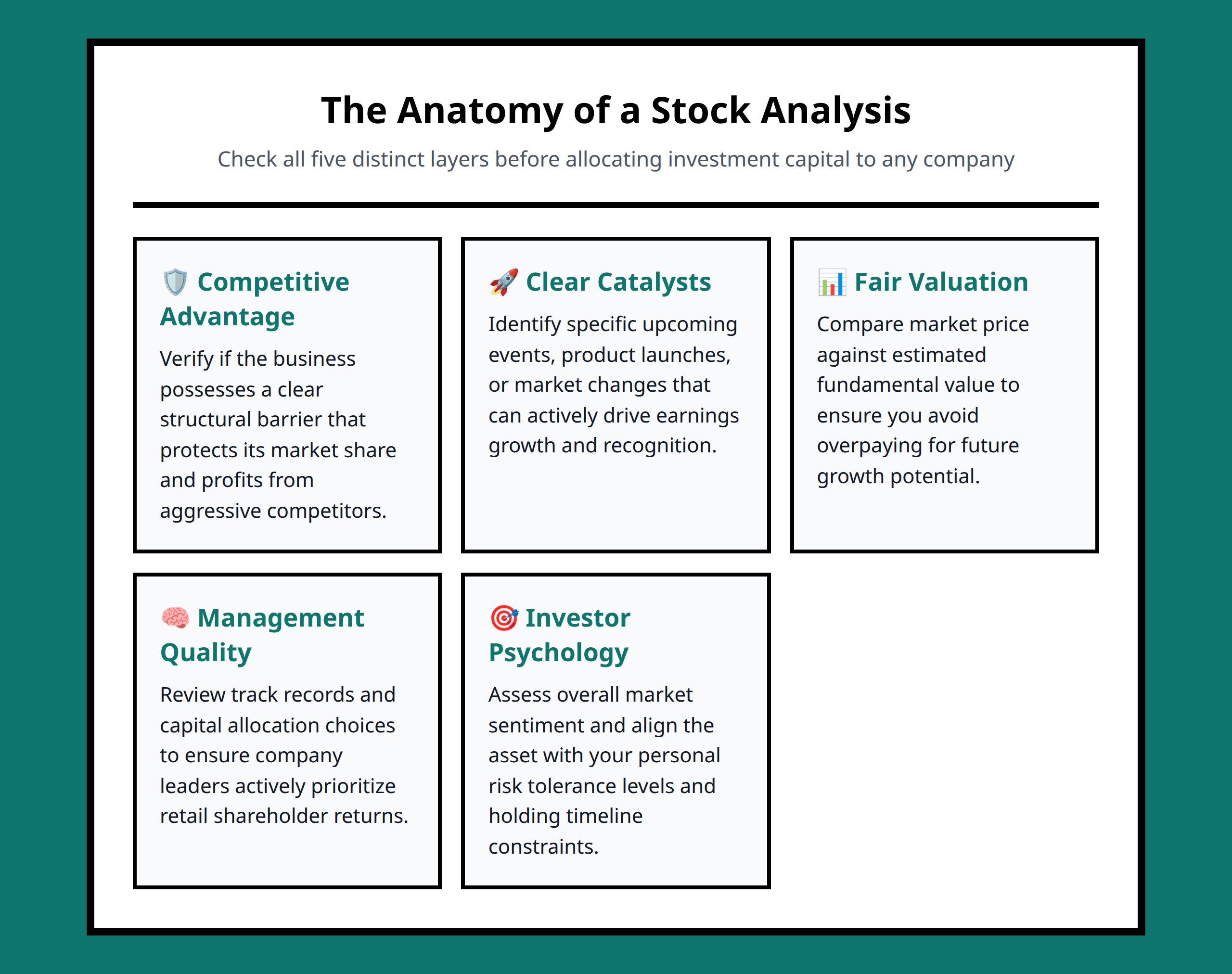
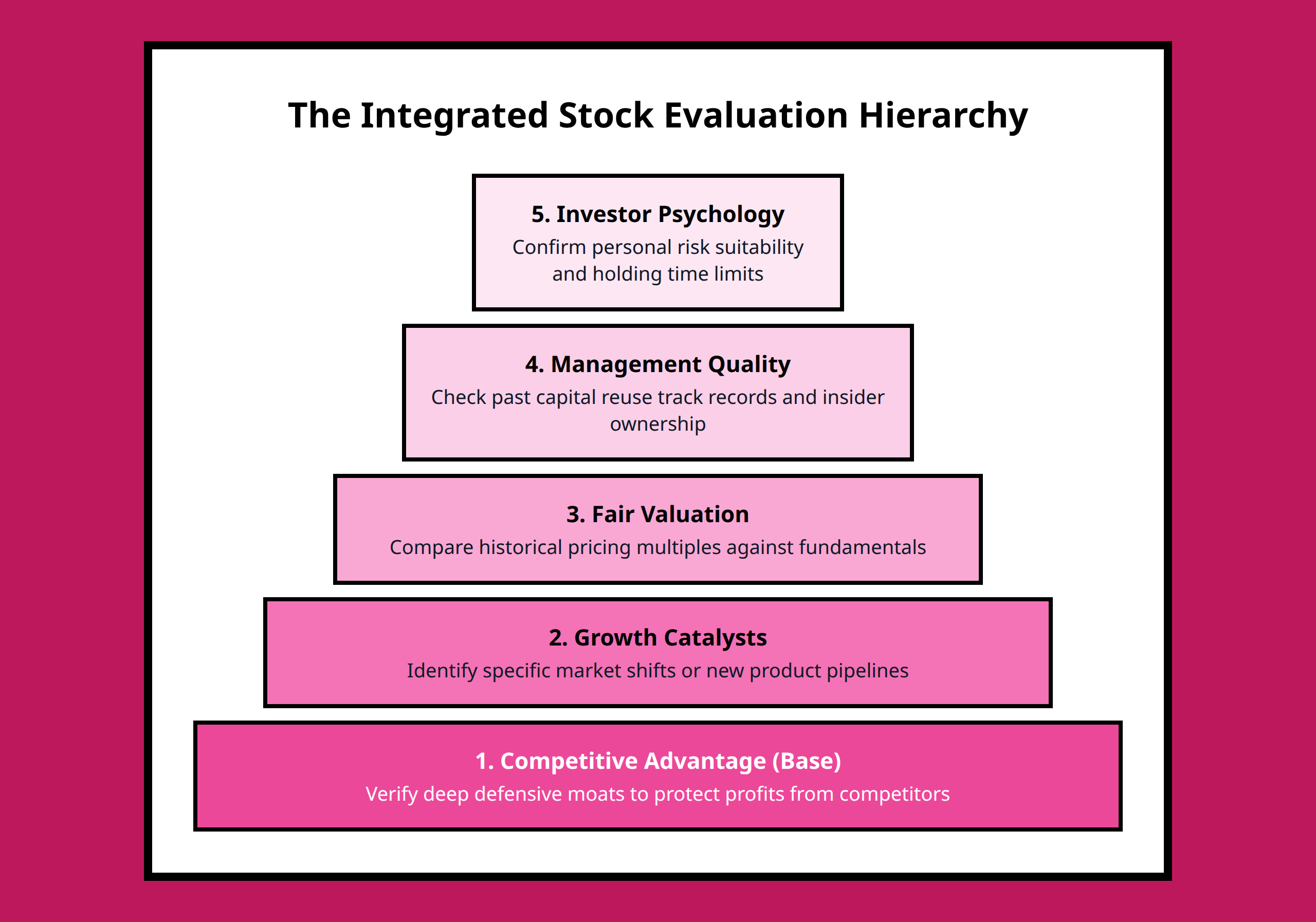
This is why structured investors tend to evaluate businesses through broader frameworks rather than single indicators. One of the most practical approaches is analyzing stocks through five connected factors: competitive advantage, catalysts, valuation, management quality, and investor psychology.
I would think about this framework less like a checklist of disconnected items and more like a business “anatomy” system. Each factor influences the others. Strong businesses usually develop durable characteristics across multiple areas rather than succeeding in only one dimension temporarily.
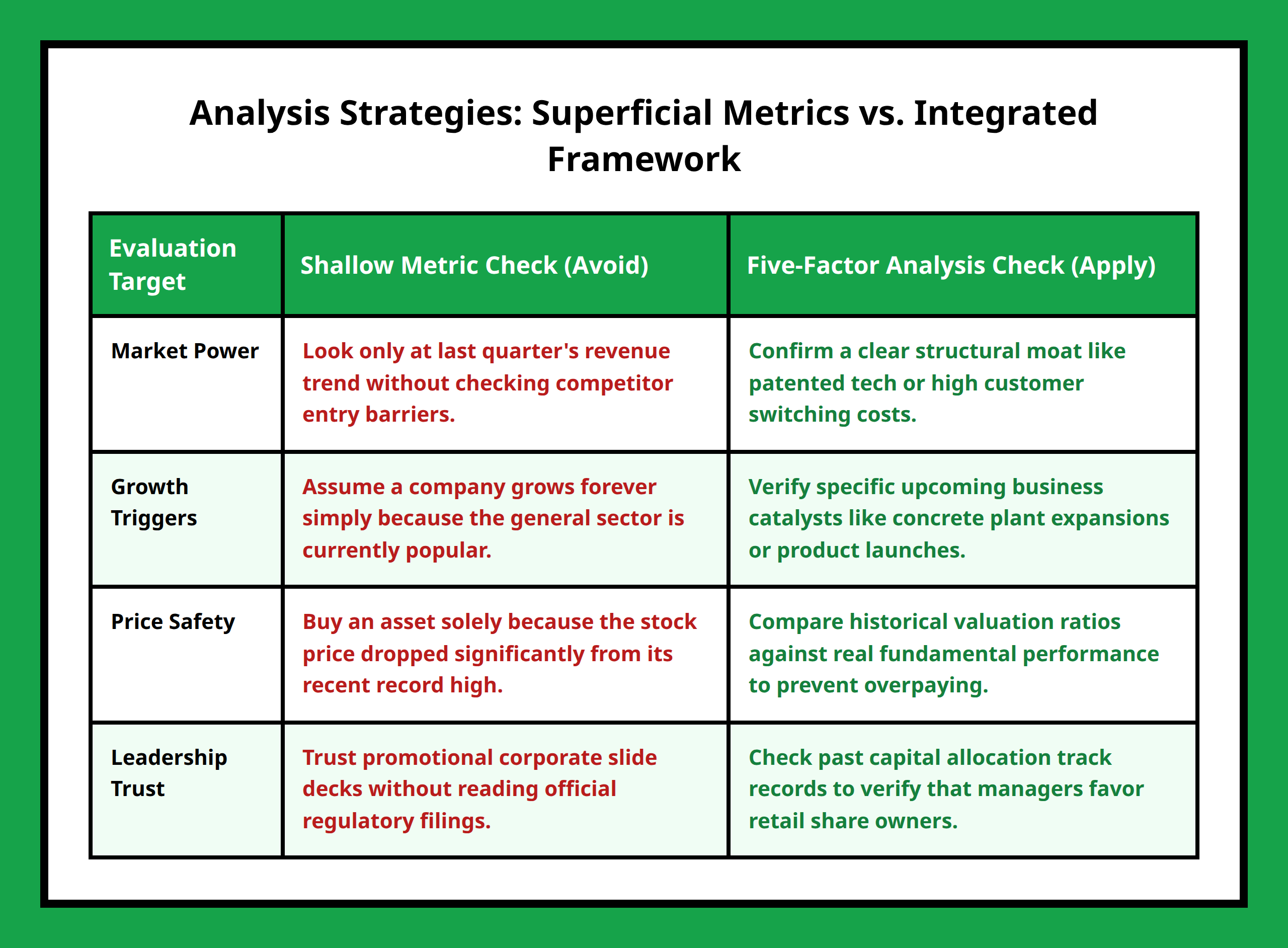
Why Single-Metric Investing Often Breaks Down
One of the easiest investing mistakes is assuming one attractive characteristic automatically creates a strong investment.
For example:
- A low P/E ratio may hide deteriorating business quality
- Rapid revenue growth may depend on unsustainable conditions
- A popular brand may still trade at irrational valuations
- A great management team may operate inside a weak industry
The important point is that businesses operate as systems. Competitive position, future growth drivers, financial durability, leadership decisions, and investor expectations all interact simultaneously.
I find this distinction useful because many retail investors accidentally evaluate stocks the same way consumers evaluate products. They focus on the most visible characteristic instead of examining the full structure supporting long-term performance.
The Five Factors That Shape Long-Term Investment Quality
A disciplined framework helps investors move beyond emotional reactions and surface-level analysis.
The five-factor model works because it combines:
- Business quality
- Future growth potential
- Valuation discipline
- Leadership evaluation
- Market psychology awareness
Each factor answers a different question about the investment opportunity.
| Factor | Core Question |
|---|---|
| Competitive Advantage | Why can this business remain strong? |
| Catalysts | What could improve future performance? |
| Valuation | Is the stock reasonably priced? |
| Management Quality | Can leadership allocate capital effectively? |
| Investor Psychology | Is sentiment distorting pricing? |
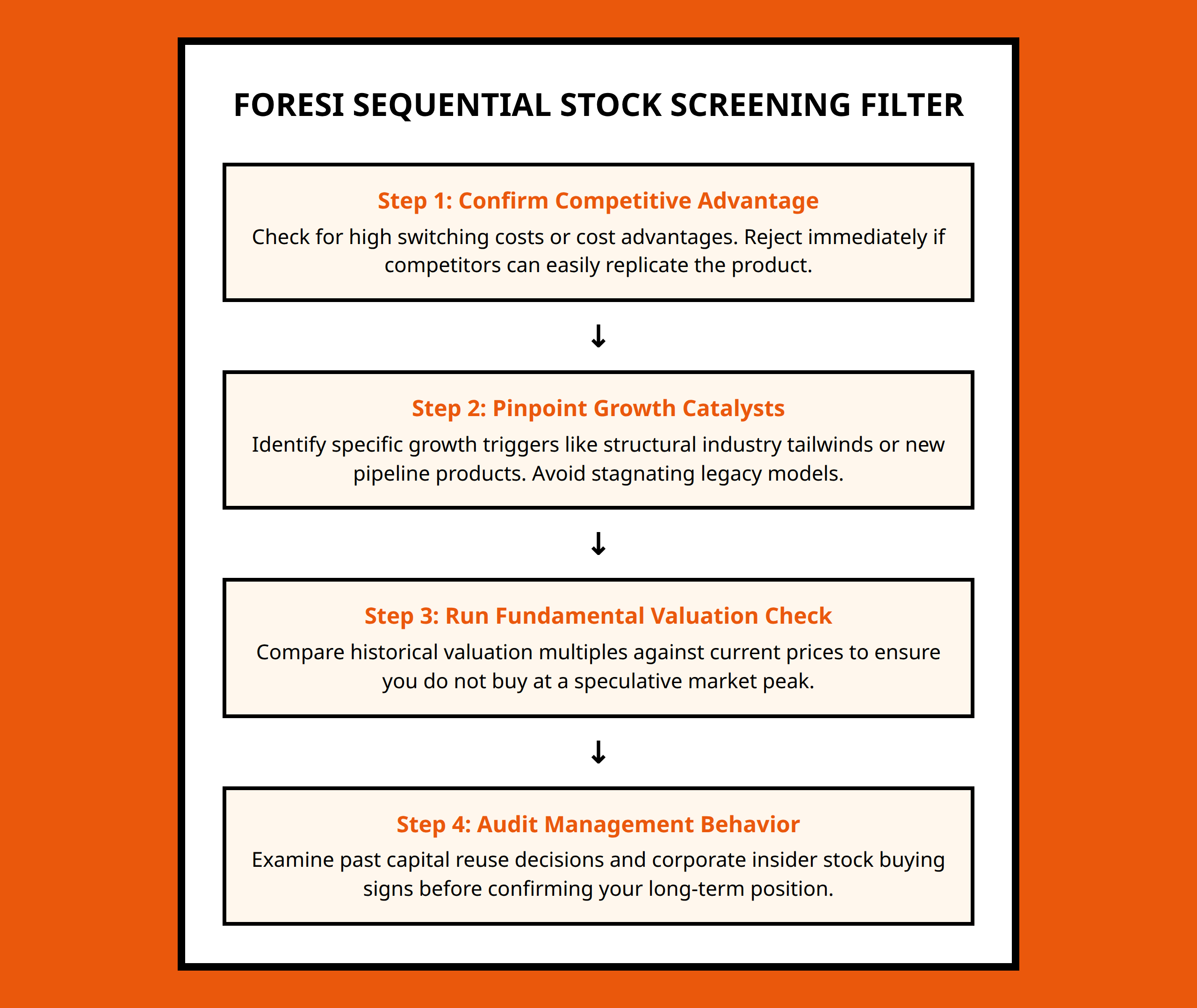
The strength of the framework is that it forces investors to analyze businesses from multiple perspectives before making decisions.
Factor 1: Competitive Advantage Determines Durability
Competitive advantage is often the foundation of long-term business quality.
Strong companies usually possess characteristics that make them difficult to disrupt or replace. These advantages may include:
- Brand strength
- Network effects
- Customer loyalty
- Switching costs
- Operational scale
- Cost efficiency
- Distribution advantages
A useful practical example is the difference between a commodity business and a dominant platform business. Commodity companies often compete primarily on price, making profitability unstable. Businesses with durable ecosystems or entrenched customer relationships may maintain pricing power much longer.
I would avoid thinking about competitive advantage as permanent immunity. Even strong companies can lose relevance over time. The more important question is whether the business possesses structural strengths that improve resilience across market cycles.
Factor 2: Catalysts Drive Future Expectations
Markets care heavily about future expectations, not only historical performance.
This is where catalysts become important. A catalyst is a development that could meaningfully improve business performance, earnings potential, or investor perception over time.
Examples may include:
- New product launches
- Market expansion
- Margin improvement
- Operational restructuring
- Industry shifts
- Capital allocation changes
The important distinction is that catalysts are forward-looking. Investors who focus only on historical numbers may miss changes that alter future economics substantially.
A practical example is a software company transitioning from one-time licensing revenue toward recurring subscription revenue. Historical financials may initially appear weaker during the transition, while long-term business quality improves significantly.
I think many investors underestimate how heavily stock prices depend on changing expectations rather than static business snapshots.
Factor 3: Valuation Protects Against Overpaying
Even excellent businesses can become poor investments if purchased at irrational prices.
Valuation matters because investing returns depend not only on business quality, but also on the relationship between price and underlying value.
This does not mean valuation is purely mathematical precision. Markets are uncertain, future cash flows are imperfectly predictable, and assumptions constantly evolve.
The more practical role of valuation is risk management.
| Weak Valuation Discipline | Strong Valuation Discipline |
|---|---|
| Assumes growth will remain perfect | Allows room for uncertainty |
| Depends heavily on optimism | Focuses on downside protection |
| Ignores emotional market cycles | Recognizes sentiment distortions |
| Confuses great business with great investment | Separates business quality from stock price |
I would not reduce valuation analysis to memorizing formulas alone. The bigger purpose is understanding whether current market expectations already assume unrealistic outcomes.
Factor 4: Management Quality Shapes Long-Term Outcomes
Leadership quality influences how effectively businesses allocate capital, respond to competition, manage risk, and navigate changing environments.
Strong management teams often demonstrate:
- Clear strategic thinking
- Disciplined capital allocation
- Operational consistency
- Long-term decision-making
- Shareholder alignment
Weak leadership, meanwhile, can damage even strong business models through poor acquisitions, excessive leverage, inconsistent execution, or short-term thinking.
A practical example is how two companies in the same industry can produce dramatically different shareholder outcomes because one leadership team reinvests capital intelligently while the other prioritizes short-term expansion without operational discipline.
I find management analysis especially important because investors sometimes treat leadership quality as secondary compared with financial metrics. In reality, management decisions often shape whether competitive advantages strengthen or erode over time.
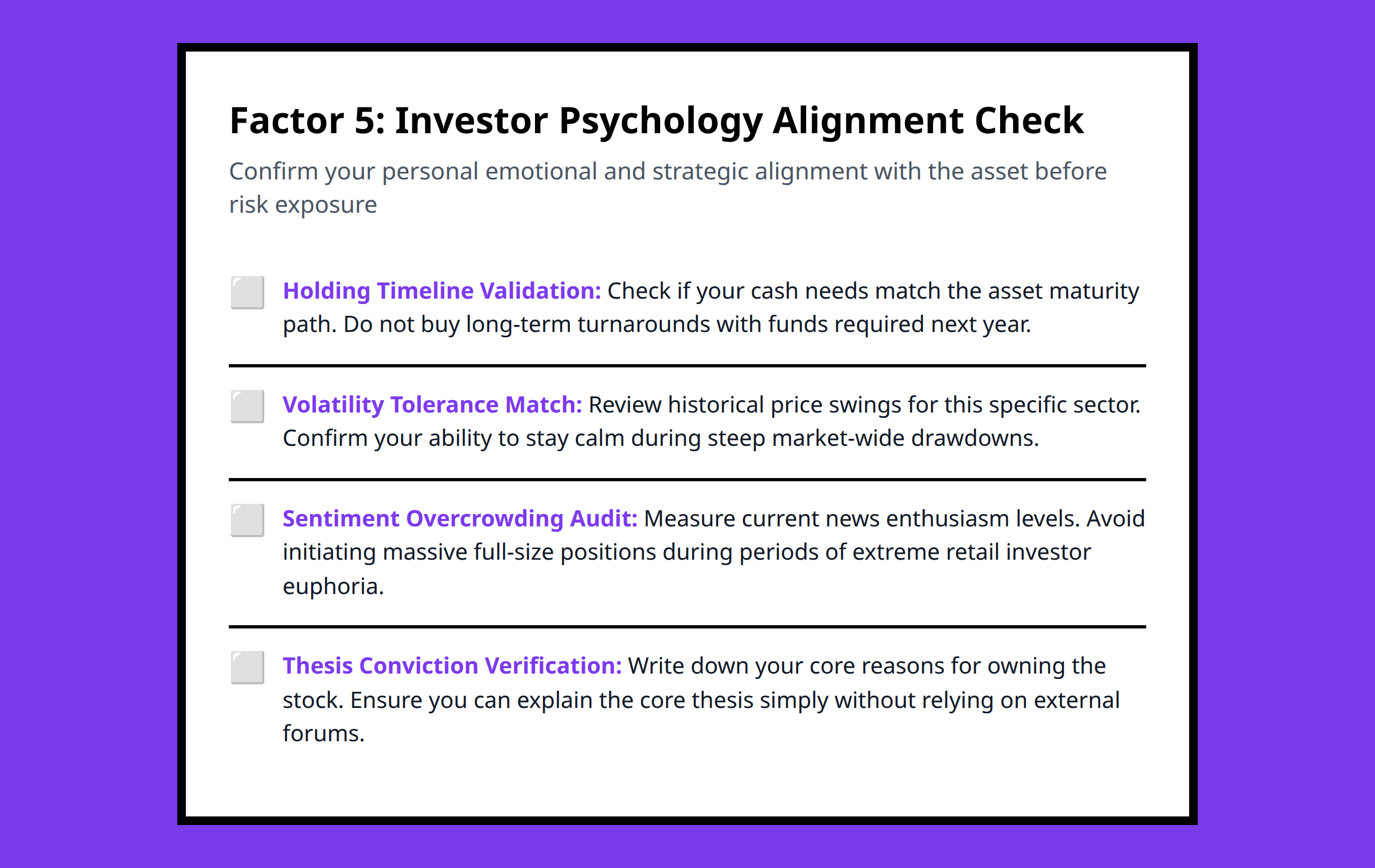
Factor 5: Investor Psychology Creates Mispricing Opportunities
Markets are influenced heavily by human behavior.
Fear, greed, momentum, optimism, pessimism, and narrative-driven excitement all affect pricing. This means investor psychology itself becomes part of investment analysis.
For example:
- Strong companies may become undervalued during panic-driven selloffs
- Popular growth narratives may inflate valuations excessively
- Short-term fear may overshadow long-term fundamentals
- Momentum enthusiasm may weaken analytical discipline
The important lesson is not assuming markets are always irrational. Markets can remain efficient for long periods. But emotional extremes frequently create temporary disconnects between price and business reality.
I would think about psychology as the factor connecting all the others. Competitive advantage, catalysts, valuation, and management quality all matter — but investor emotion often determines how aggressively the market prices those characteristics at any moment.
Why the Five Factors Work Better Together
The real strength of the framework appears when the factors reinforce one another.
A high-quality investment opportunity often looks something like this:
- A durable business with competitive strength
- Future catalysts supporting continued growth
- Reasonable or attractive valuation
- Strong leadership execution
- Market sentiment temporarily underestimating the opportunity
Meanwhile, weak investments often reveal imbalance across the framework.
For example:
- Strong growth but weak valuation discipline
- Popular narratives but poor competitive durability
- Cheap valuation but deteriorating business quality
- Good management trapped in structurally weak industries
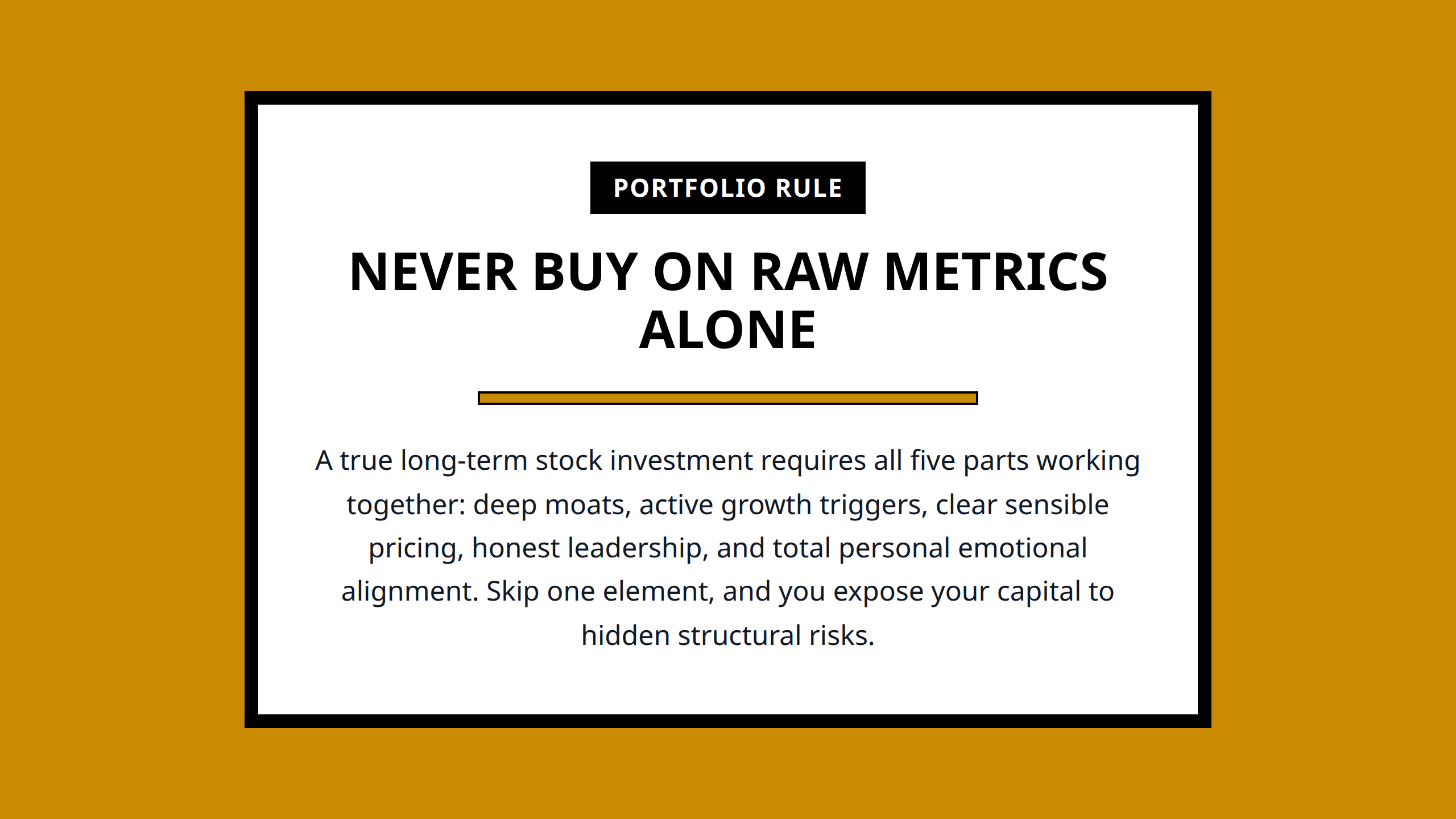
This interconnected structure is what makes the framework useful. It prevents investors from becoming overly dependent on isolated signals.
How Investors Can Use This Framework Practically
You do not need institutional-level research infrastructure to apply this framework effectively.
A simple structured review process already improves decision quality significantly.
Before investing, ask:
| Factor | Diagnostic Question |
|---|---|
| Competitive Advantage | What protects this business from competitors? |
| Catalysts | What could improve future earnings or sentiment? |
| Valuation | Does current pricing assume unrealistic optimism? |
| Management | Has leadership allocated capital intelligently? |
| Psychology | Is the market emotionally overreacting? |
This structure helps investors slow down, think more clearly, and avoid purely emotional decision-making.
Why Strong Investing Usually Requires Balance
One of the biggest mistakes investors make is searching for a single perfect signal. Markets rarely work that cleanly.
Strong long-term investing usually comes from balancing multiple realities simultaneously:
- Business quality and valuation
- Growth and risk
- Opportunity and uncertainty
- Market psychology and fundamental analysis
The five-factor framework matters because it encourages integrated thinking instead of isolated thinking. It forces investors to evaluate not just whether a company looks attractive superficially, but whether the full structure supporting the investment remains durable, rationally priced, and psychologically misunderstood enough to justify long-term conviction.
References:
- https://www.josephforesi.com/
- https://www.amazon.com.au/Anatomy-Stock-Fundamental-Analysis-Investors-ebook/dp/B0GQTGN21B
- https://www.amazon.com.au/Anatomy-Stock-Fundamental-Analysis-Investors/dp/1041168454
- https://public.com/learn/how-to-make-sense-of-wall-street-analyst-ratings
- https://www.wallstrank.com/learn/what-are-analyst-ratings-and-how-do-you-interpret-them
- https://digitalcommons.uri.edu/oa_diss/1667/
- https://www.linkedin.com/posts/josephdforesi_its-here-anatomy-of-a-stock-a-guide-to-activity-7465371235950981121-d4dC
- https://www.booksamillion.com/p/Anatomy-Stock/Joseph-D-Foresi/9781041168454
- https://www.researchgate.net/publication/275978868_The_Need_for_Efficient_Investment_Fundamental_Analysis_and_Technical_Analysis
- https://www.blackrock.com/us/financial-professionals/investments/products/factor-etfs
- https://www.wealthsimple.com/en-ca/learn/fundamental-analysis
- https://www.investopedia.com/financial-edge/0411/5-essential-things-you-need-to-know-about-every-stock-you-buy.aspx
- https://www.finra.org/investors/investing/investment-products/stocks/evaluating-stocks
