One of the most dangerous assumptions in investing is believing markets can be reduced to a reliable formula. Investors naturally search for certainty because uncertainty feels uncomfortable. They look for indicators, systems, patterns, or strategies that promise predictable outcomes. But markets rarely stay stable long enough for rigid frameworks to work indefinitely.
This is why the idea that “the only predictable thing about markets is their unpredictability” matters so much. It changes how investors think about risk, volatility, cycles, and even the purpose of analysis itself.
I would think about it this way: markets are not machines following fixed equations. They are dynamic systems shaped by economics, psychology, liquidity, narratives, fear, greed, and constantly changing expectations. Any investing approach that assumes markets behave consistently forever eventually runs into problems.
Why Investors Keep Searching for Permanent Market Formulas
People are naturally attracted to systems that appear simple, repeatable, and controllable. In investing, this often creates the belief that there must be a permanent strategy capable of consistently predicting market behavior.
Examples appear constantly:
- Technical setups believed to “always work”
- Economic indicators treated as guaranteed signals
- Bull-market strategies mistaken for universal strategies
- Narratives that claim a “new era” has permanently changed markets
The deeper issue is not the existence of patterns themselves. Markets absolutely do develop recurring behaviors. The problem is assuming those patterns remain stable regardless of changing conditions.
I find this distinction useful because many investing mistakes happen when investors confuse temporary effectiveness with permanent truth.
Why Market Unpredictability Is Structural, Not Temporary
Many investors treat volatility and unpredictability as interruptions to an otherwise stable system. In reality, unpredictability is part of the system itself.
Markets constantly process:
- New economic information
- Interest-rate changes
- Corporate earnings
- Geopolitical shocks
- Investor sentiment
- Liquidity conditions
- Unexpected events
Each new variable changes expectations, and expectations heavily influence pricing.
This creates an environment where certainty becomes extremely fragile. A strategy that works well during low-interest-rate growth cycles may struggle badly during inflationary or recessionary environments. Momentum-driven speculation may perform strongly during euphoric markets and collapse during liquidity stress.
The important implication is that markets are adaptive. As conditions change, investor behavior changes with them.
Why Rigid Investing Systems Often Break Down
One of the recurring problems with rigid investing systems is that they often assume historical relationships will continue unchanged.
For example:
- A valuation metric may work well in one economic environment but fail in another
- A trading strategy may depend heavily on abundant liquidity
- A market regime may reward speculative growth for years before suddenly prioritizing profitability and cash flow
This does not mean all systems are useless. Structure and discipline remain extremely important. The issue is inflexibility.
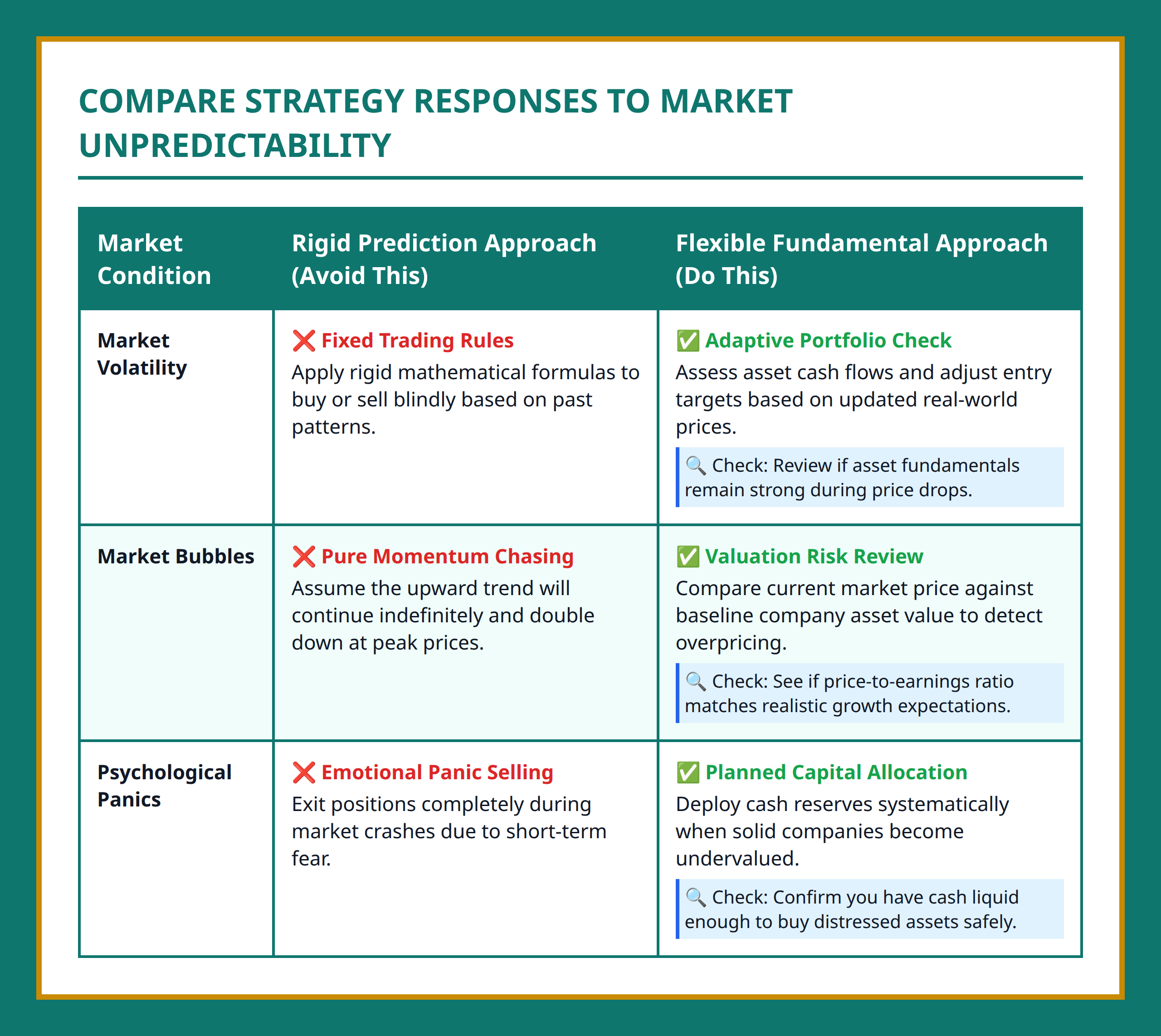
A rigid investor often tries forcing the market into the framework. A flexible investor adapts the framework to changing market realities.
| Rigid Investing Mindset | Flexible Investing Mindset |
|---|---|
| Assumes market behavior stays stable | Assumes conditions evolve constantly |
| Relies heavily on fixed formulas | Uses frameworks as adaptable tools |
| Searches for certainty | Manages uncertainty |
| Focuses on prediction | Focuses on probabilities and risk |
| Often reacts poorly to regime changes | Adjusts as cycles change |
One practical observation I would make here is that investors often mistake confidence for competence during stable market periods. Strategies can appear brilliant simply because market conditions temporarily favor them.
How Bubbles Reveal the Limits of Predictability
Market bubbles are powerful reminders that markets are influenced by psychology as much as fundamentals.
During bubbles, investors often begin believing traditional valuation rules no longer matter. Narratives dominate analysis. Speculative enthusiasm replaces disciplined skepticism.
The progression usually follows a recognizable pattern:
- A strong theme captures investor attention
- Early gains attract more participants
- Optimism increases rapidly
- Valuation discipline weakens
- Fear of missing out drives additional buying
- Prices disconnect from realistic assumptions
The important point is not that every rapidly rising market represents irrationality. Strong trends can reflect real economic shifts. The danger appears when investors begin treating continued appreciation as inevitable.
I would not frame bubbles simply as intelligence failures. Often they emerge because recent success creates emotional reinforcement. Investors start believing recent market behavior is permanent precisely when conditions become most unstable.
Why Volatility Is Not Always the Same as Risk
One reason unpredictability confuses investors is that short-term volatility often feels identical to long-term danger.
But those concepts are not always the same.
A profitable company experiencing temporary market fear may face volatility without fundamental deterioration. Meanwhile, a highly speculative company with weak economics may appear stable temporarily while carrying substantial hidden risk.
This distinction matters because unpredictable markets constantly blur the line between price movement and business reality.
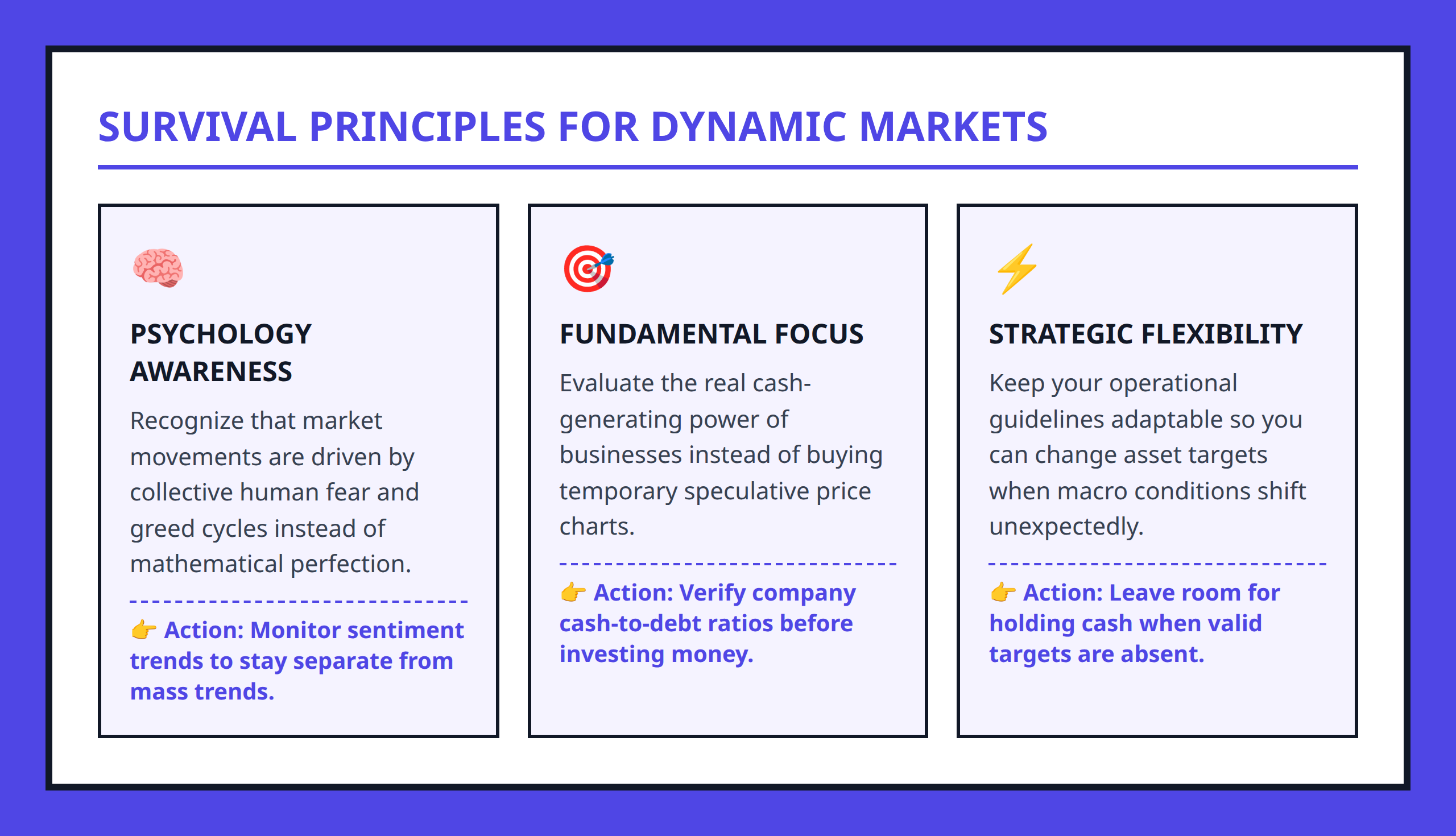
A flexible fundamental investor tries separating:
- Temporary emotional volatility
- Structural business deterioration
- Narrative-driven price behavior
- Long-term cash-generating ability
That process does not eliminate uncertainty, but it creates a more stable framework for decision-making.
Why Psychology Makes Markets Less Predictable
Markets would likely behave very differently if all investors processed information rationally and consistently. In practice, psychology creates recurring distortions.
Fear and greed influence:
- Risk tolerance
- Time horizons
- Valuation assumptions
- Market narratives
- Buying and selling intensity
These emotional shifts often amplify market cycles.
For example, during strong bull markets:
- Risk appears smaller than it really is
- Growth assumptions expand aggressively
- Speculation feels safer because recent gains reinforce confidence
During market stress, the opposite occurs:
- Fear expands rapidly
- Investors prioritize short-term survival
- Even strong businesses may be sold indiscriminately
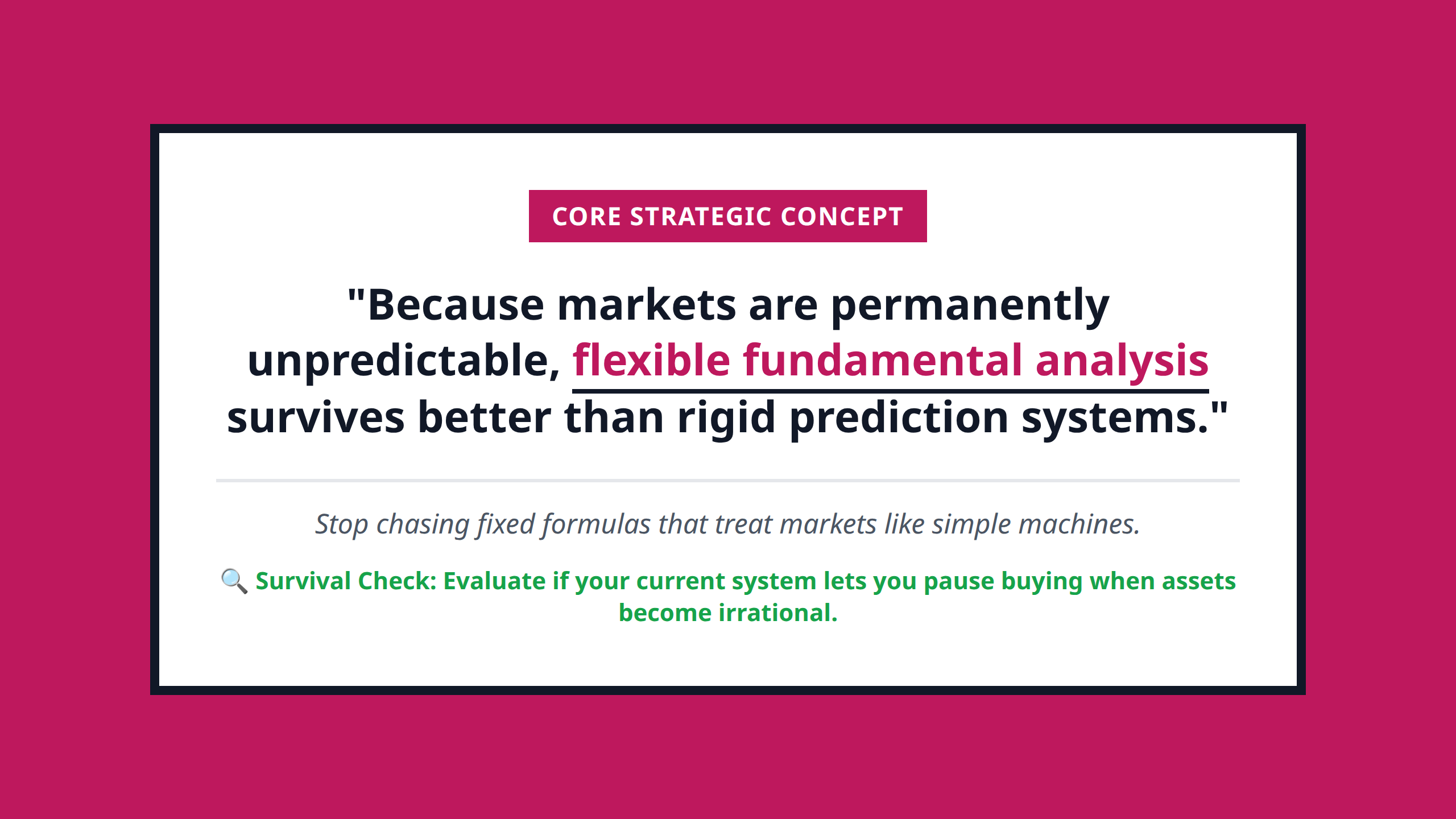
This emotional instability is one reason rigid prediction systems struggle. Human behavior itself changes across cycles.
What Flexible Fundamental Investing Actually Means
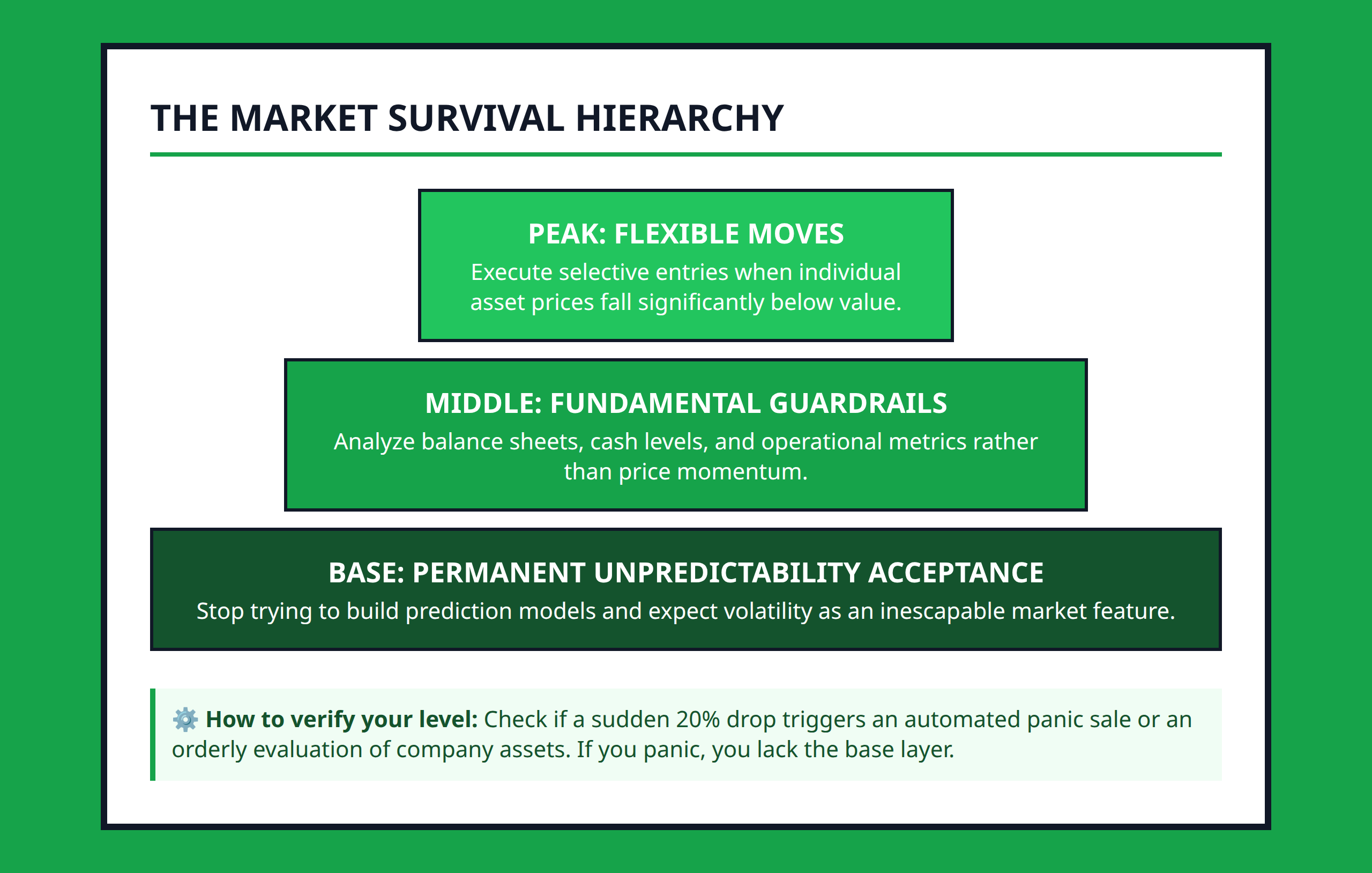
Flexibility does not mean abandoning discipline. It means recognizing that markets operate under changing conditions and incomplete information.
A flexible fundamental investor still values:
- Business quality
- Competitive advantages
- Cash generation
- Balance-sheet strength
- Risk management
- Valuation discipline
But instead of treating markets as perfectly predictable, the investor approaches analysis probabilistically.
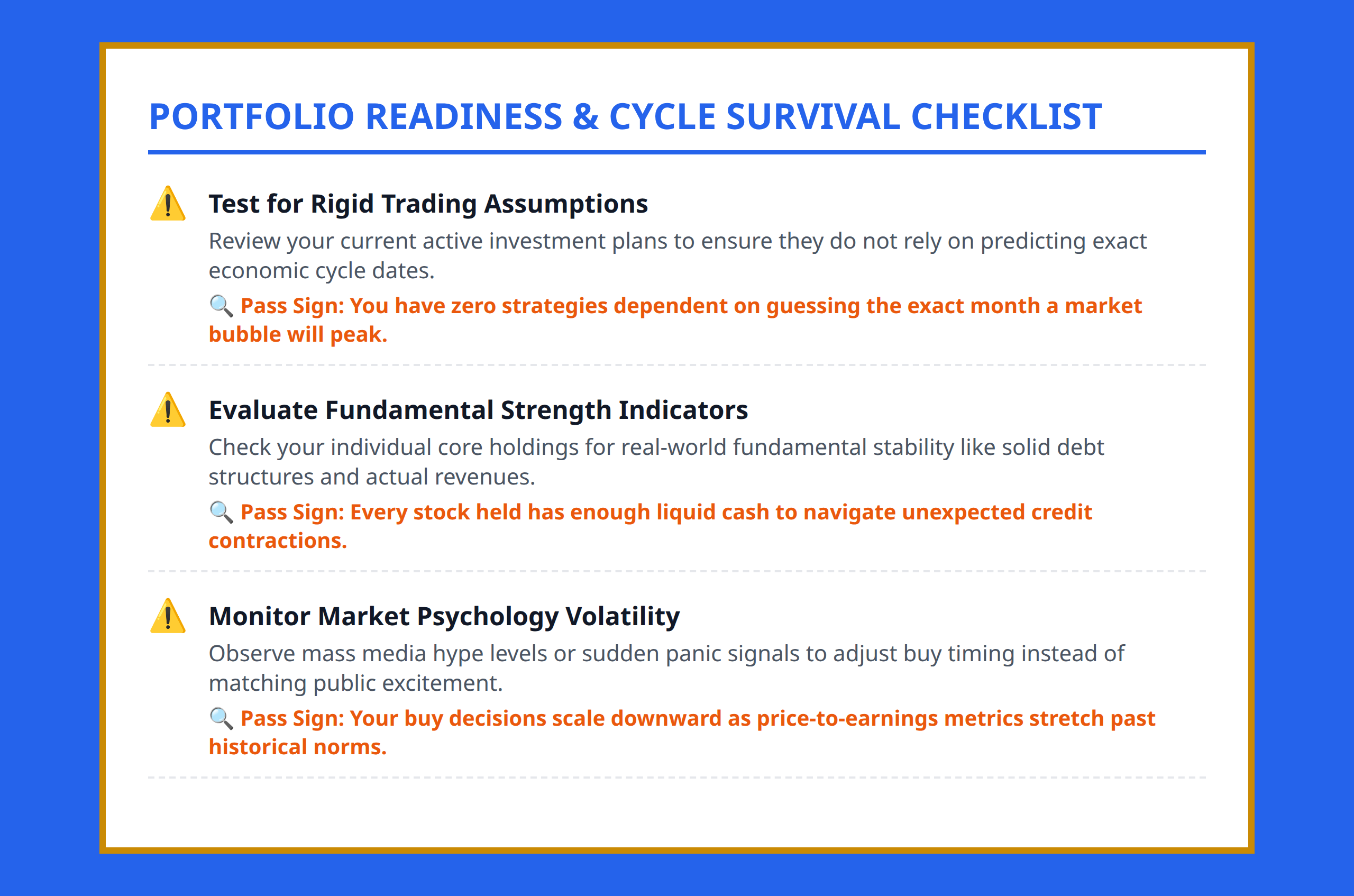
This means asking:
- What assumptions am I relying on?
- What conditions could change?
- What risks is the market underestimating?
- Am I becoming emotionally influenced by recent trends?
- Does current pricing already assume perfect outcomes?
I think this is one of the most practical mindset shifts investors can make. Good investing is often less about predicting exact outcomes and more about surviving uncertainty intelligently.
How Unpredictability Changes Risk Management
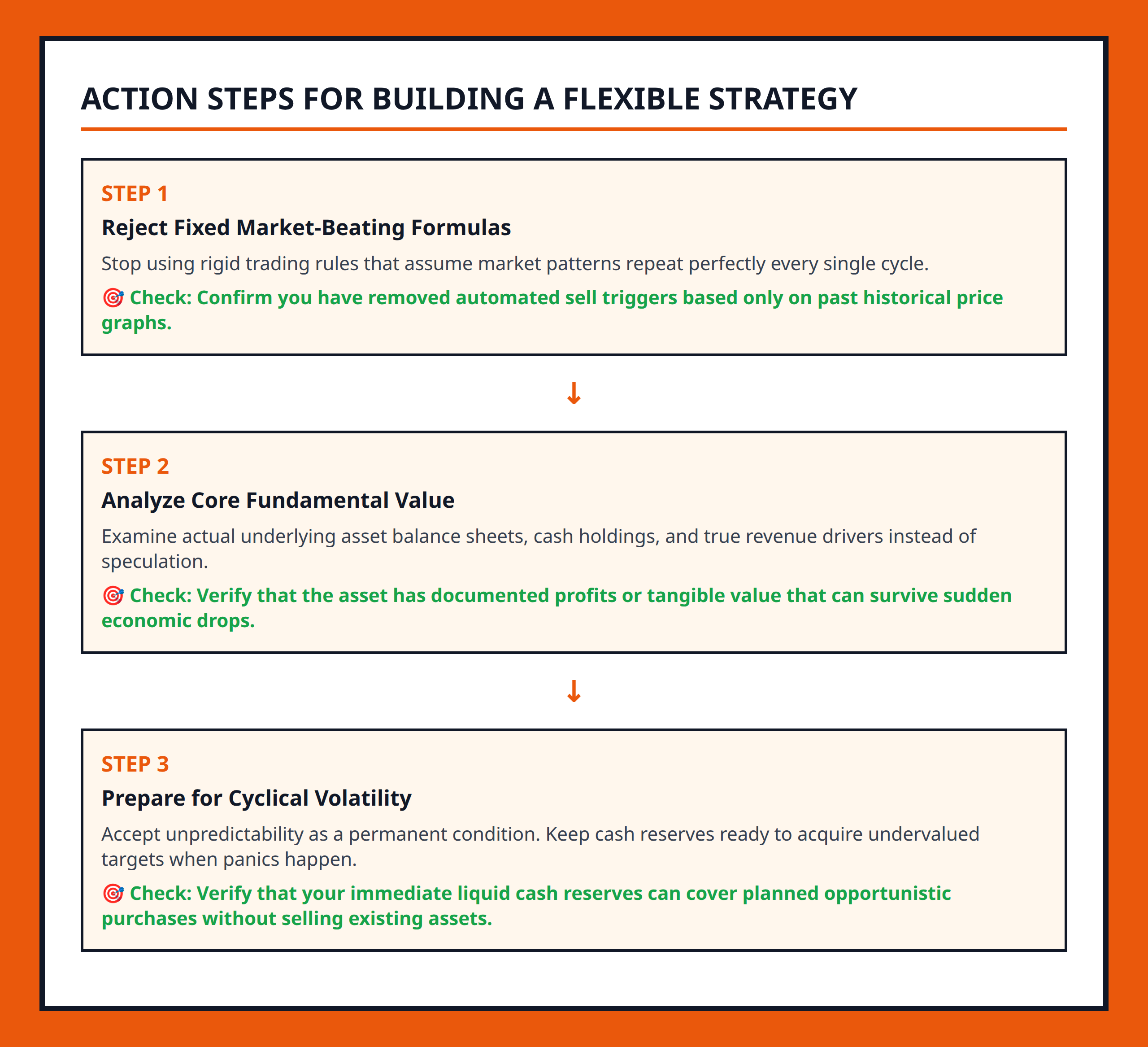
Once unpredictability is accepted as permanent, risk management becomes far more important than precise forecasting.
This changes investor priorities.
Instead of trying to predict every market movement, disciplined investors focus more on:
- Avoiding catastrophic mistakes
- Maintaining diversification where appropriate
- Controlling emotional reactions
- Avoiding excessive leverage
- Demanding reasonable valuation margins
- Building adaptable decision frameworks
A practical example is how investors handle uncertainty around future growth. A rigid investor may assume optimistic growth projections are guaranteed. A flexible investor may acknowledge growth potential while still preparing for slower execution, competitive pressure, or changing economic conditions.
That difference sounds subtle, but it significantly changes portfolio resilience during unstable periods.
Why Unpredictability Can Actually Improve Investor Thinking
Accepting unpredictability sounds uncomfortable initially because people naturally prefer certainty. But intellectually, it can create healthier investing behavior.
Investors who acknowledge uncertainty tend to:
- Become more humble about forecasting
- Focus more on risk-adjusted decisions
- Avoid excessive confidence during bubbles
- React less emotionally to short-term volatility
- Think in probabilities rather than guarantees
The irony is that investors often become more disciplined once they stop believing markets can be predicted precisely.
Unpredictability does not make investing pointless. It changes the goal of investing itself. Instead of searching for a flawless system that predicts every market move, disciplined investors build flexible frameworks capable of surviving changing cycles, emotional extremes, and imperfect information.
Markets will likely remain volatile, emotional, cyclical, and occasionally irrational for as long as humans participate in them. That reality makes adaptability more valuable than rigid certainty.
