Most investing mistakes do not begin with bad companies. They begin with bad process. A stock gets attention on social media, a friend mentions a ticker, or a chart suddenly looks exciting. The purchase happens first, while the research happens later — if it happens at all. That habit creates emotional investing, inconsistent decisions, and unnecessary risk. A repeatable stock research process changes the entire dynamic because it forces you to slow down, ask better questions, and separate market noise from business reality.
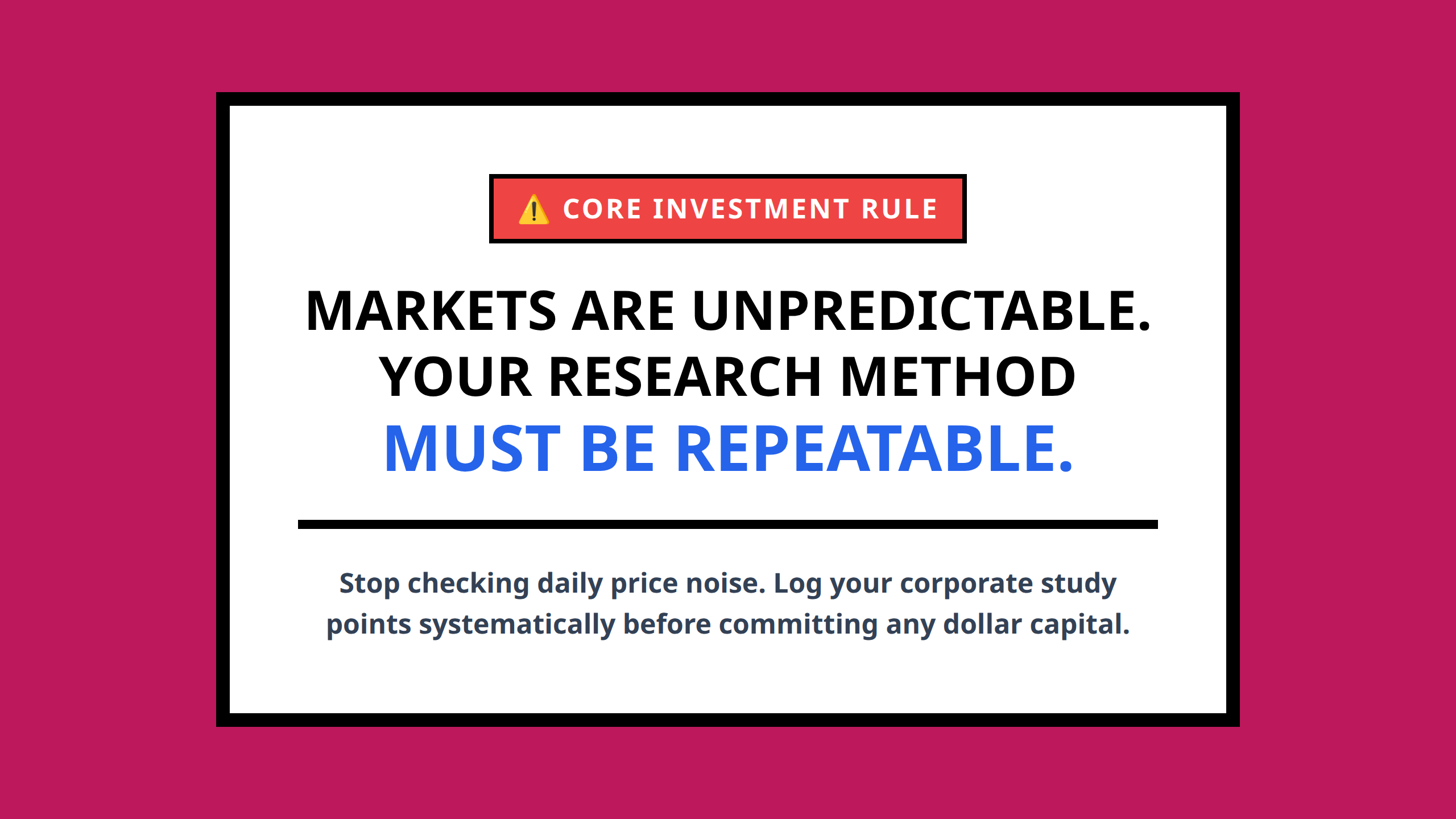
The uncomfortable truth is that markets are unpredictable in the short term. Prices move because of psychology, fear, excitement, narratives, liquidity, and macro events that no investor fully controls. That unpredictability is exactly why disciplined investors rely on process instead of instincts. A strong process does not eliminate mistakes, but it reduces avoidable ones.
Why “Hunch Investing” Usually Breaks Down
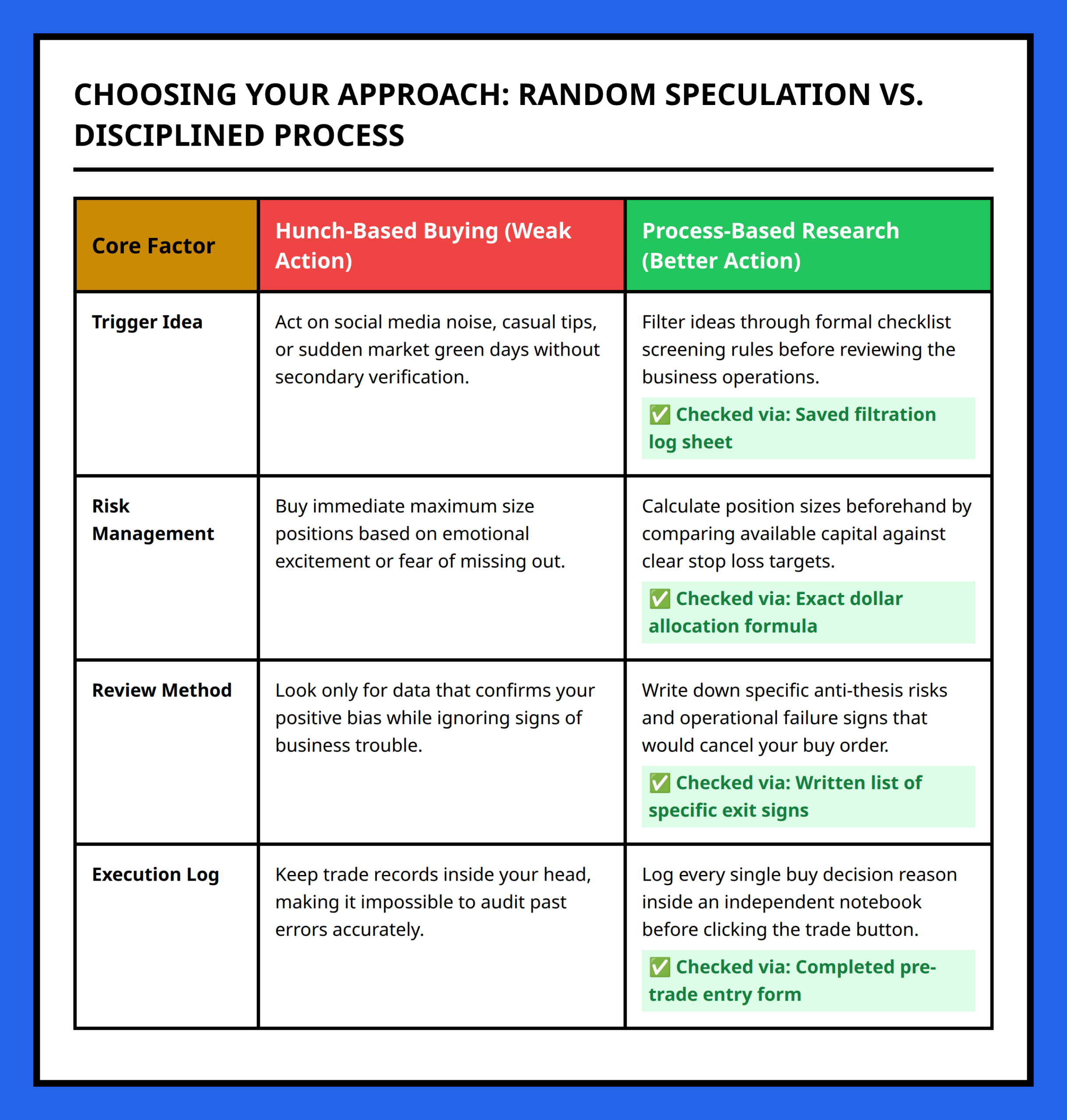
One of the easiest traps in investing is confusing activity with analysis. Many retail investors spend hours watching prices move without spending even thirty minutes understanding the underlying business. The stock becomes the focus instead of the company.
I find this distinction extremely important because speculative behavior often feels productive in the moment. Fast decisions create emotional excitement. Research feels slower and less dramatic. But over time, excitement-driven investing usually turns into reaction-driven investing.
There are several common patterns behind hunch-based investing:
- Buying because a stock already went up quickly
- Following recommendations without understanding the business
- Confusing market popularity with business quality
- Reacting emotionally to headlines or price swings
- Making decisions without a defined reason to buy or sell
The deeper problem is not intelligence. It is the absence of structure. Without a framework, every market move feels important and every opinion feels persuasive.
Markets Reward Discipline More Than Prediction
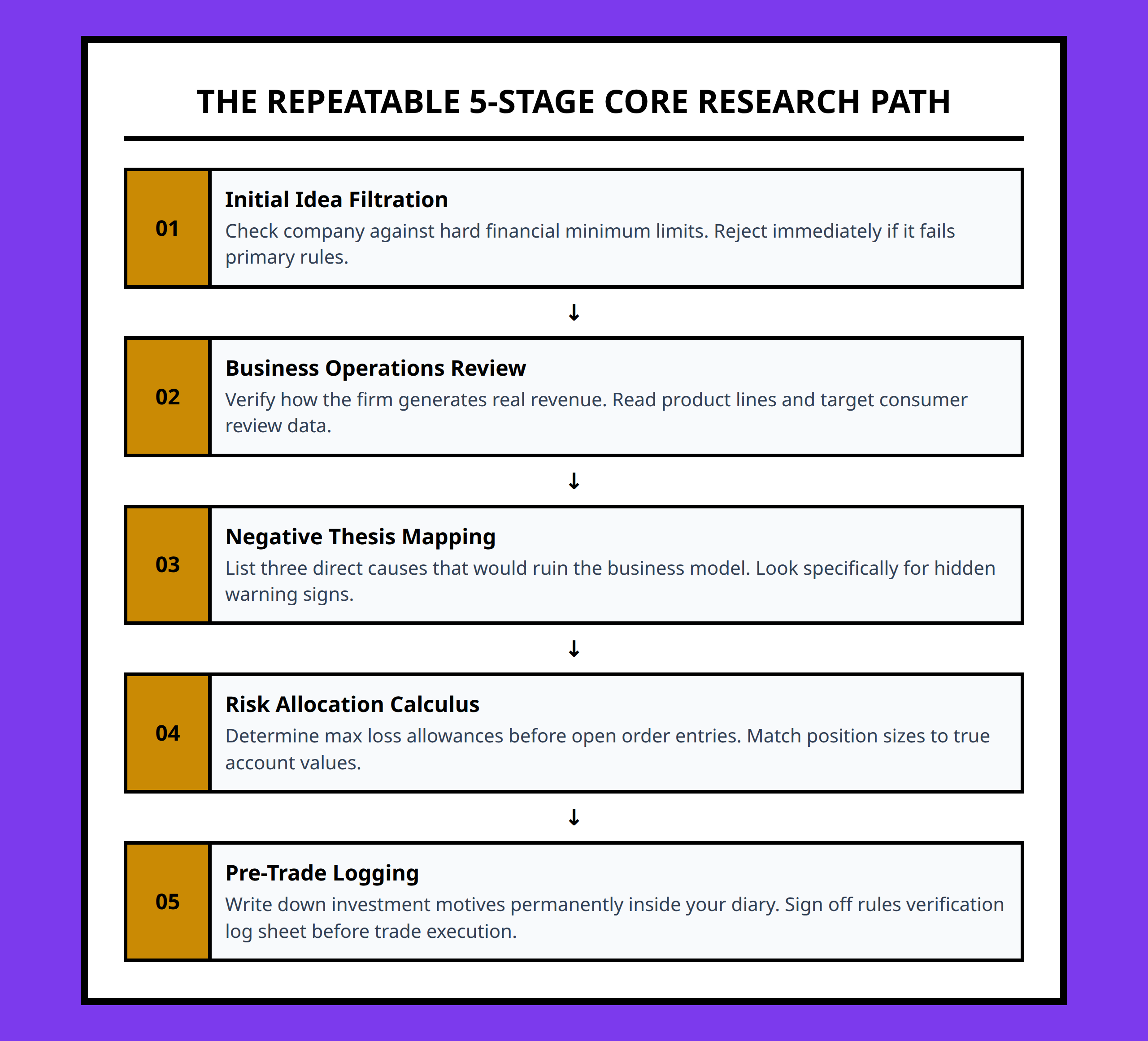
A surprising number of investors approach the market like a prediction contest. They search for certainty, exact timing, or a perfect formula that guarantees success. Markets rarely cooperate with that mindset.
Economic cycles shift. Investor sentiment changes. Entire sectors move in and out of favor. Even strong companies can experience sharp short-term declines because market psychology and business fundamentals are not always aligned.
That creates an important distinction:
| Short-Term Market Behavior | Long-Term Business Reality |
|---|---|
| Driven by emotion and sentiment | Driven by earnings and cash generation |
| Highly volatile | Usually slower and more measurable |
| Influenced by headlines and narratives | Influenced by competitive strength and execution |
| Often irrational | Eventually tied to business performance |
A disciplined process helps investors survive the first column long enough to benefit from the second.
I would think about investing this way: you are not trying to predict every market movement. You are trying to consistently make higher-quality decisions with incomplete information.
The Shift From Outcome Thinking to Process Thinking
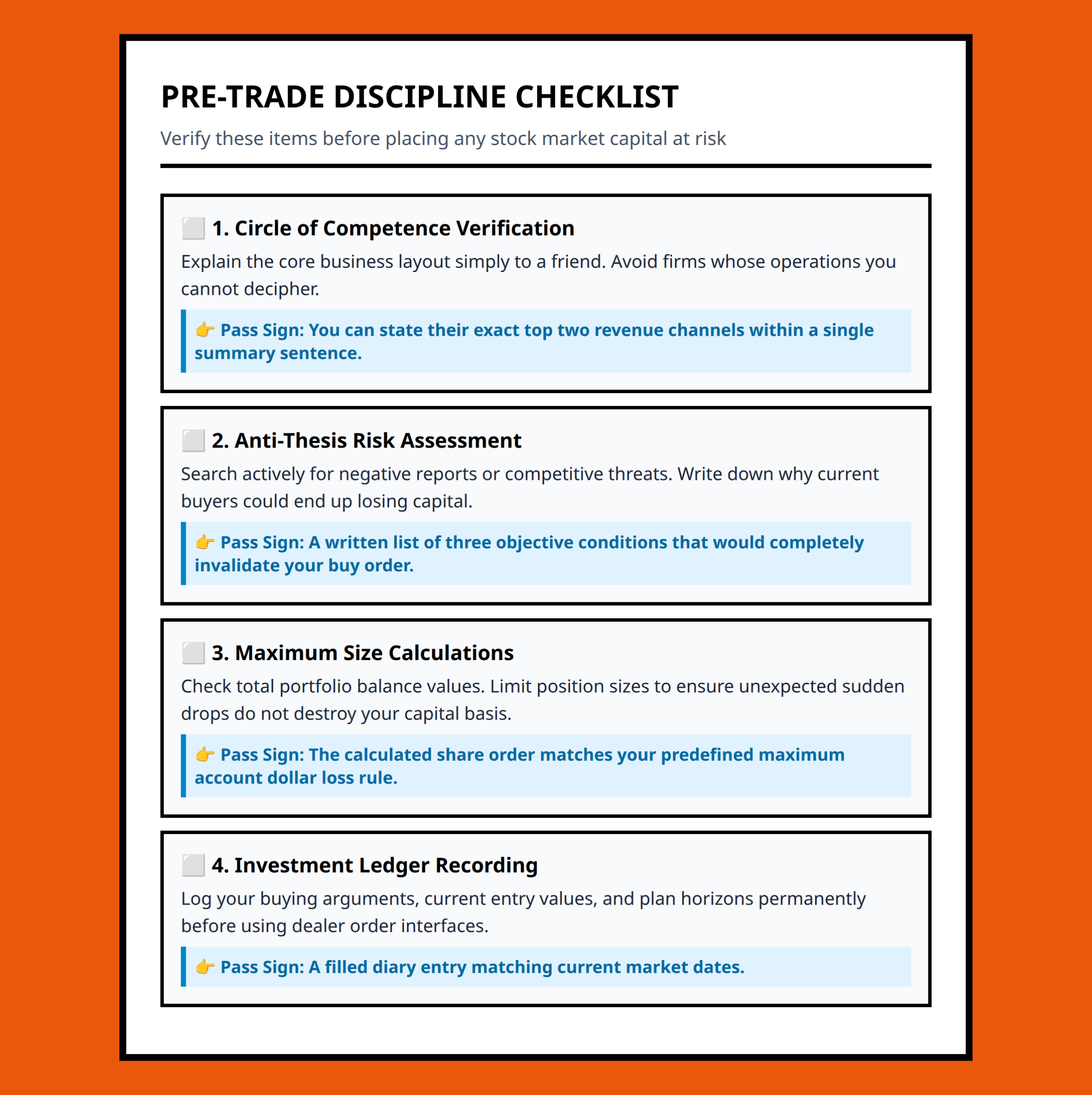
Many investors judge decisions only by outcomes. If a stock rises after purchase, the decision feels smart. If the stock falls, the decision feels wrong.
That mindset creates dangerous habits because markets can reward bad decisions temporarily and punish good decisions temporarily.
Process-focused investors think differently. Instead of asking:
“Did this stock go up?”
They ask:
“Was the decision based on sound reasoning, disciplined research, and proper risk evaluation?”
This is one of the biggest mental shifts beginner investors need to make. Good investing is not about being right every time. It is about consistently improving decision quality.
A Simple Repeatable Stock Research Workflow
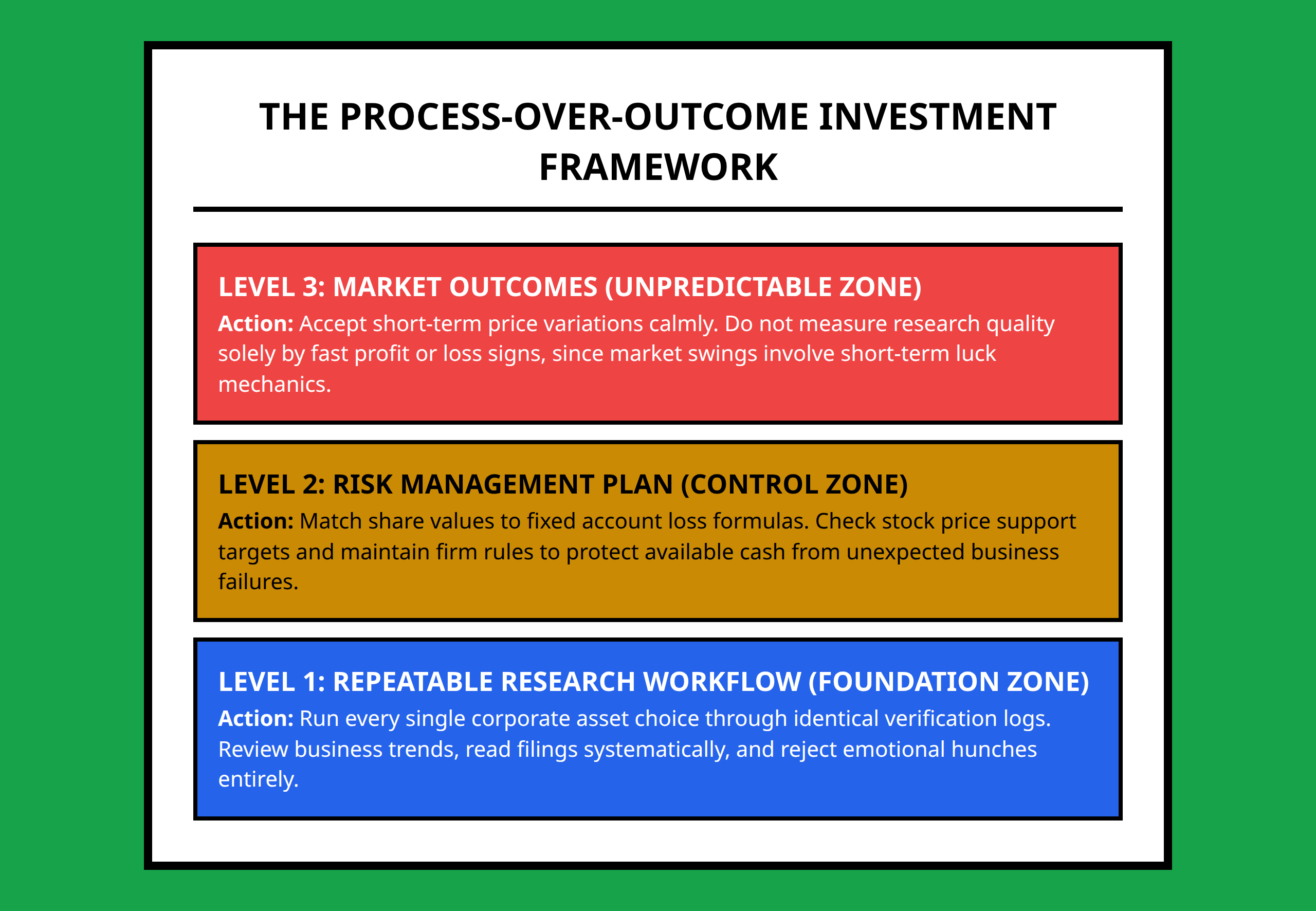
A repeatable process does not need to be complicated. In fact, overly complex systems often become impossible to maintain consistently.
The goal is to create a workflow that helps you move from curiosity to informed conviction.
Step 1: Start With the Big Picture
Before analyzing individual companies, it helps to understand the broader environment. Markets move through cycles. Economic conditions influence consumer behavior, business investment, borrowing costs, and investor sentiment.
You do not need to become a macroeconomist. The point is simply to avoid analyzing companies in isolation.
For example:
- High interest rates may pressure highly leveraged businesses
- Weak consumer confidence can hurt discretionary spending companies
- Economic slowdowns may affect cyclical industries differently than defensive industries
This step creates context instead of prediction.
Step 2: Stay Inside Your Circle of Competence
One of the most useful filters in investing is understanding what you actually understand.
A retail investor who works in healthcare may naturally understand medical workflows, insurance systems, or patient behavior better than semiconductor manufacturing. Someone working in software may recognize strong SaaS business models faster than commodity businesses.
The mistake I would avoid here is pretending expertise exists where it does not. Investors often lose discipline when they move into businesses they cannot explain clearly.
A simple diagnostic question helps:
“Could I explain how this company makes money to someone else in plain language?”
If the answer is no, the research probably is not deep enough yet.
Step 3: Screen for Businesses Worth Researching
Research becomes easier when you narrow the field early.
Instead of analyzing random stocks, create basic filters that align with your goals. Those filters might include:
- Consistent revenue growth
- Strong profitability trends
- Reasonable debt levels
- Industry leadership
- Stable cash generation
This stage is not about finding perfect companies. It is about removing obvious weak candidates before deeper research begins.
Step 4: Build a Basic Business Understanding
At this point, many investors jump straight into valuation ratios. That is usually too early.
First understand the business itself:
- What does the company actually sell?
- Who are its customers?
- What makes the business competitive?
- How does it generate revenue?
- What could realistically disrupt it?
A strong research process treats the business model as the foundation. Financial metrics matter, but numbers without business understanding can become misleading.
For example, two companies may both show strong earnings growth. One may have durable competitive advantages and recurring demand, while the other may simply benefit from a temporary market trend.
Step 5: Identify Competitive Strength
Great businesses often have characteristics that protect them from competitors. These protections may include:
- Brand strength
- Network effects
- Switching costs
- Scale advantages
- Customer loyalty
- Operational efficiency
This matters because long-term investing depends heavily on business durability.
A useful practical example is payment networks such as Visa or Mastercard. Their value does not come from hype alone. Their strength comes from global infrastructure, network scale, merchant acceptance, and entrenched relationships that become difficult to replicate.
The key lesson is not to chase famous companies. It is to understand why certain businesses remain strong for long periods.
Step 6: Look for Future Catalysts
Markets care less about the past than many investors assume. Expectations about the future matter more.
Strong research includes identifying potential drivers of future performance, such as:
- New product growth
- Expanding markets
- Margin improvement
- Operational efficiencies
- Industry shifts
- Capital allocation improvements
For example, a software company entering enterprise markets may create a very different future earnings profile than its historical numbers suggest.
This is where investing becomes forward-looking instead of purely historical.
Step 7: Define the Risk Before Buying
Many investors research upside extensively while barely analyzing downside risk.
A disciplined process forces both sides into the conversation.
Ask questions like:
- What could break the investment thesis?
- What assumptions am I relying on?
- Is management execution critical?
- Could industry conditions reverse?
- Am I depending on unrealistic growth?
One practical habit that improves discipline is writing down the specific reason for buying the stock before purchasing it. That written reasoning becomes extremely useful later when emotions increase during volatility.
Why Process Reduces Emotional Investing
Investors often assume emotions disappear with experience. They usually do not. Even experienced investors feel fear and excitement during major market swings.
The difference is that disciplined investors rely on structure during stressful periods.
For example, imagine two investors during a sharp market decline:
- Investor A bought based on social momentum and has no framework for evaluating the business.
- Investor B researched the company, understood its balance sheet, identified competitive strengths, and defined risks before investing.
Investor A experiences panic because there is no analytical anchor. Investor B may still feel uncomfortable, but the research process provides context.
This is one reason process matters so much. It stabilizes decision-making when markets become emotionally unstable.
A Practical Stock Research Checklist You Can Actually Reuse
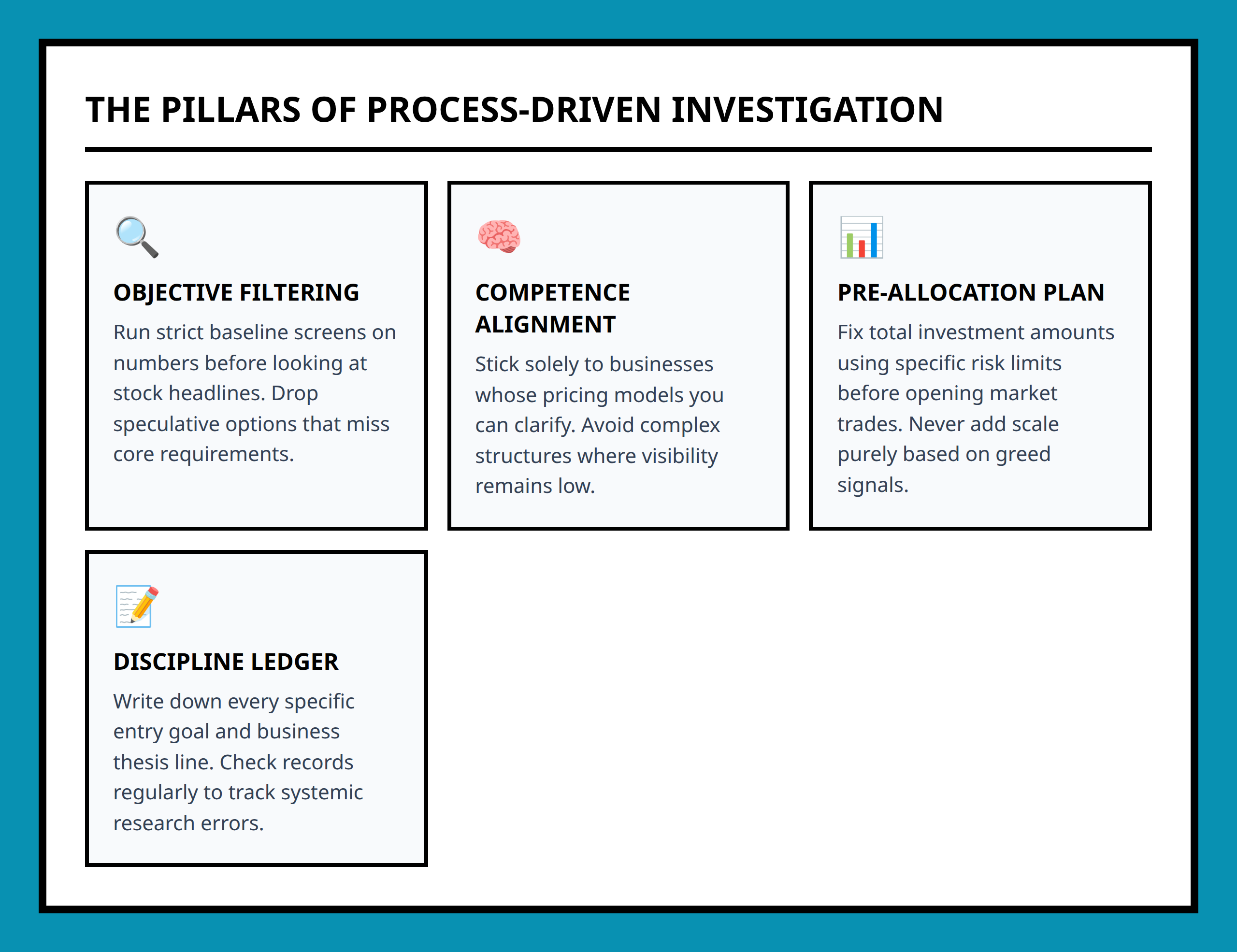
You do not need institutional-level complexity to become more disciplined. A simple repeatable checklist is often more effective than complicated spreadsheets that never get updated.
| Research Area | Key Question |
|---|---|
| Business Model | How does the company make money? |
| Industry | Is the industry growing or shrinking? |
| Competitive Position | Why can this company stay strong? |
| Financial Health | Is the balance sheet stable? |
| Growth Drivers | What could improve future performance? |
| Risks | What could realistically go wrong? |
| Investment Thesis | Why exactly am I buying this stock? |
The value of a checklist is not perfection. The value is consistency.
What a Good Research Process Really Does
A repeatable investment process will not remove uncertainty from markets. No framework can do that. But it changes how uncertainty is handled.
Instead of reacting emotionally to every price movement, you begin evaluating businesses through a stable lens. Instead of relying on luck, tips, or momentum alone, decisions become grounded in analysis, risk awareness, and structured thinking.
That shift matters more than finding a perfect stock.
The investors who survive long enough to compound wealth usually are not the ones making the boldest predictions. They are the ones who consistently avoid avoidable mistakes, stay disciplined during volatility, and keep refining a process that helps them think clearly when markets become noisy.
References:
- https://www.pimco.com/gb/en/insights/a-systematic-lens-on-global-equity-opportunities-within-multi-asset-portfolios
- https://playingfordoubles.substack.com/p/how-to-research-stocks-using-ai-agents
- https://www.ft.com/content/838cbeb0-502c-496a-af08-6e7dd8e71daf
- https://www.morningstar.in/posts/55308/6-guidelines-smart-equity-investor.aspx
- https://www.quant-investing.com/blog/best-formula-investing-strategies-long-term-tested
- https://www.linkedin.com/posts/alpeshbpatel_chatgpt-and-stock-picking-hedge-fund-manager-activity-7338601212197408771-XifJ
- https://www.reddit.com/r/HENRYfinance/comments/1ljhyp5/how_to_stop_the_urge_of_wanting_to_buy_individual/
- https://www.reddit.com/r/HENRYfinance/comments/1ljhyp5/how_to_stop_the_urge_of_wanting_to_buy_individual/mzjwrl0/
- https://acquirersmultiple.com/category/michael-mauboussin/
- https://www.motiontrader.com.au/resources/investment-insights/what-is-momentum-investing/
- https://www.bajajamc.com/knowledge-centre/strategies-to-survive-in-stock-market-crash
